
The short answer
The best concealed carry gun for most people in 2026 is the SIG Sauer P365: a 9mm micro-compact that carries 10+1 rounds in a 1.1-inch-wide, 17.8-ounce package, with manual-safety and optics-ready versions. If you want more capacity, get the Springfield Hellcat (11+1/13+1); on a budget, the S&W Shield Plus ($499 MSRP); if you struggle to rack a slide, the S&W Shield EZ.
Choosing a carry gun is a balancing act. The smaller and lighter a pistol gets, the easier it is to carry every day — and the harder it is to shoot well. The bigger it gets, the easier it is to shoot — and the more likely it is to end up in a drawer instead of on your belt. The best concealed carry gun is the one you will actually carry, can shoot accurately under stress, and trust to work every time.
This guide compares 20 of the most widely carried pistols and revolvers available in October 2026. For every gun we list the manufacturer’s published specifications, explain who it suits and who should skip it, and flag recalls, safety notices and discontinued models so you don’t buy a problem. It is the hub of this site: each section links to deeper guides on the topics that decide the choice.
Quick picks: the best concealed carry guns of 2026
- Best Overall: SIG Sauer P365
- Best High-Capacity Micro-Compact: Springfield Armory Hellcat
- Best Value Micro-Compact: S&W M&P9 Shield Plus
- Best Slimline Glock: Glock 43X MOS
- Best for Capacity: SIG P365-XMACRO
- Best Compact (All-Around): Glock 19
- Best Slim Long-Slide: Glock 48 MOS
- Best for Smaller Hands: Walther PDP F-Series
- Best for Beginners (Easy to Rack): S&W M&P9 Shield EZ
- Best Budget Pick: Canik METE MC9
- Best Pocket Pistol: Ruger LCP MAX
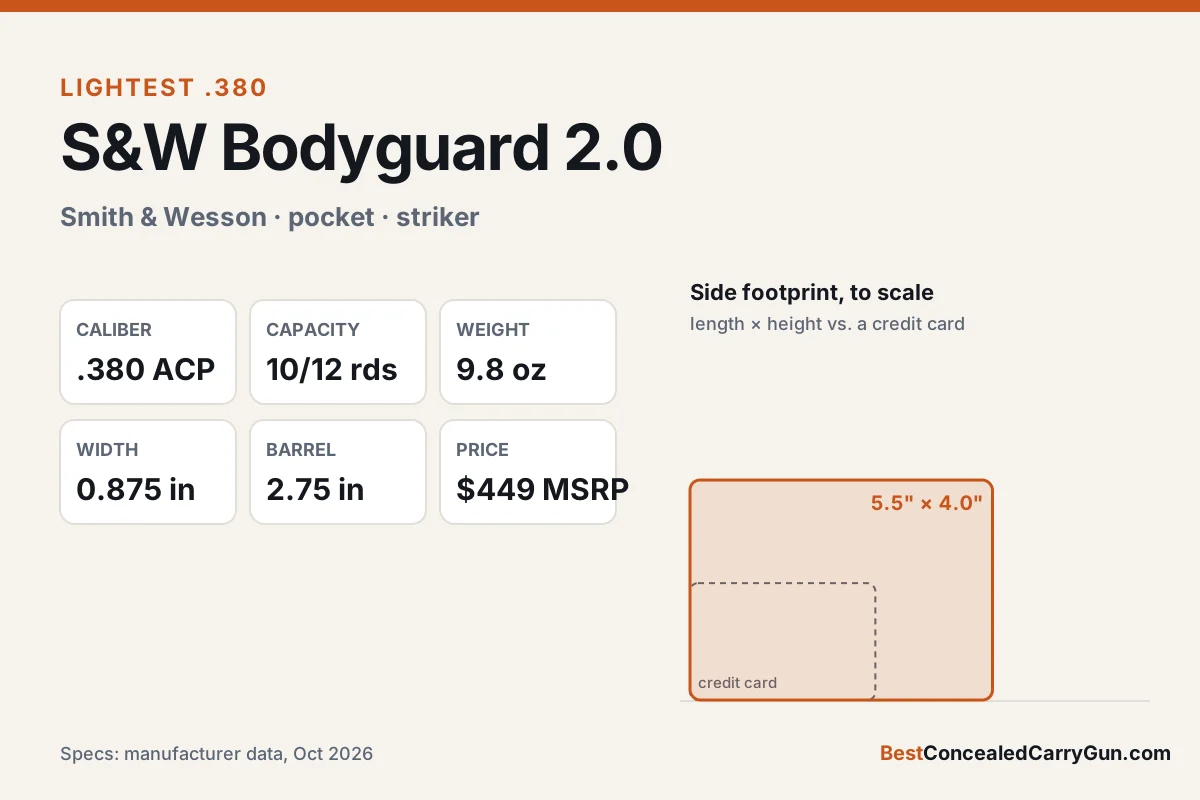
- Lightest .380: S&W Bodyguard 2.0
The top 5 concealed carry handguns at a glance
If you only want the short list, these five cover most people. They are also among the best-selling handguns in the country: GunGenius’s 2025 GunBroker sales data ranked the SIG P365 first, the Glock 19 second and the Glock 43X third among all handguns.
| # | Handgun | Why it’s here | Capacity | Weight | Price |
|---|---|---|---|---|---|
| 1 | SIG Sauer P365 | Best balance of size, capacity and support | 10 | 17.8 oz | $500 MSRP |
| 2 | Springfield Armory Hellcat | Most capacity in the smallest package | 11/13 | 17.9 oz | $653 MSRP |
| 3 | S&W M&P9 Shield Plus | Best value, optional thumb safety | 10/13 | 17.9 oz | $499 MSRP |
| 4 | Glock 43X MOS | Slim, simple, full-length grip | 10 | 18.55 oz | $484 street |
| 5 | SIG P365-XMACRO | 17+1 in a 1.1-inch-wide gun | 10/17 | 22.0 oz | $720 MSRP |
What’s new for concealed carry guns in 2026
- Glock’s V and Gen6 pistols. Glock ended shipments of most Gen3, Gen4 and Gen5 models in late 2025, replaced the Glock 19 and 26 with V-series versions, and added an optics-ready Glock 19 Gen6 in January 2026. Holster fit can differ between generations. See the best Glock for concealed carry.
- Ruger RXM. Ruger’s 4-inch, 15-round compact built with Magpul (launched at $499 at the end of 2024) takes Glock Gen3-compatible magazines and parts. Meanwhile every MAX-9 is now marked “Limited Availability” — see our Ruger MAX-9 review.
- Staccato CS discontinued. Staccato stopped making its CS carry 2011 from November 21, 2025 and is selling remaining stock.
- Taurus GX4 safety notice. Taurus asks GX4 owners to check serial numbers for a possible drop-fire issue; we keep the GX4 off our list until you have checked yours.
- California. New pistols are reaching the state roster again (25 models in September 2026, including the Shield Plus OR and Bodyguard 2.0), while AB 1127 has blocked dealer sales of new Glock-pattern pistols since July 1, 2026. Details: best concealed carry guns in California.
- .380 versions of 9mm favorites. Springfield added a .380 Hellcat in 2025, joining the Shield EZ .380 as a softer-shooting option — see the softest-shooting carry guns.
Concealed carry gun comparison table
All 20 picks side by side. Tap a name to jump to its full write-up. On a phone, swipe the table sideways.
| Gun | Best for | Caliber | Capacity | Weight (oz) | Width (in) | Barrel (in) | Price |
|---|---|---|---|---|---|---|---|
| SIG Sauer P365 | Best Overall | 9mm | 10 | 17.8 | 1.1 | 3.1 | $500 MSRP |
| Springfield Armory Hellcat | Best High-Capacity Micro-Compact | 9mm | 11/13 | 17.9 | 1.0 | 3.0 | $653 MSRP |
| S&W M&P9 Shield Plus | Best Value Micro-Compact | 9mm | 10/13 | 17.9 | 1.1 | 3.1 | $499 MSRP |
| Glock 43X MOS | Best Slimline Glock | 9mm | 10 | 18.55 | 1.1 | 3.41 | $484 street |
| SIG P365-XMACRO | Best for Capacity | 9mm | 10/17 | 22.0 | 1.1 | 3.7 | $720 MSRP |
| Glock 19 | Best Compact (All-Around) | 9mm | 15 | 23.63 | 1.34 | 4.02 | $539 street |
| Glock 48 MOS | Best Slim Long-Slide | 9mm | 10 | 20.6 | 1.1 | 4.17 | $484 street |
| Walther PDP F-Series | Best for Smaller Hands | 9mm | 10/15 | 23.3 | 1.34 | 3.5 | $699 MSRP |
| S&W M&P9 Shield EZ | Best for Beginners (Easy to Rack) | 9mm | 8 | 23.0 | 1.04 | 3.675 | $539 MSRP |
| Canik METE MC9 | Best Budget Pick | 9mm | 12/15 | 21.27 | 1.16 | 3.19 | $440 MSRP |
| Ruger LCP MAX | Best Pocket Pistol | .380 ACP | 10/12 | 10.6 | — | 2.8 | $399 MSRP |
| S&W Bodyguard 2.0 | Lightest .380 | .380 ACP | 10/12 | 9.8 | 0.875 | 2.75 | $449 MSRP |
| Glock 42 | Softest-Shooting .380 | .380 ACP | 6 | 13.76 | 0.98 | 3.25 | $399 street |
| Ruger LCR (.38 Special +P) | Best Lightweight Revolver | .38 Special +P | 5 | 13.5 | — | 1.87 | $759 MSRP |
| S&W Model 642 | Best Classic J-Frame | .38 Special +P | 5 | 14.4 | 1.3 | 1.88 | $569 MSRP |
| Kimber K6s | Best Premium Revolver | .357 Magnum | 6 | 23.0 | 1.39 | 2.0 | $1,061 MSRP |
| Shadow Systems CR920 Elite | Best Premium Polymer Micro | 9mm | 10/13 | 17.8 | 1.05 | 3.41 | $839 MSRP |
| S&W CSX E-Series | Best Metal-Frame Micro | 9mm | 12/15/17 | 19.7 | 1.125 | 3.1 | $699 MSRP |
| CZ P-10 S | Best Subcompact Trigger | 9mm | 10/12 | 25.0 | 1.3 | 3.5 | $539 MSRP |
| Springfield Hellcat Pro | Best Hellcat for Bigger Hands | 9mm | 15/17 | 21.0 | 1.0 | 3.7 | $670 MSRP |
Specs and prices from each manufacturer’s website (October 2026). Glock does not publish MSRPs, so Glock prices are typical retail. Weights are unloaded; some makers include an empty magazine.
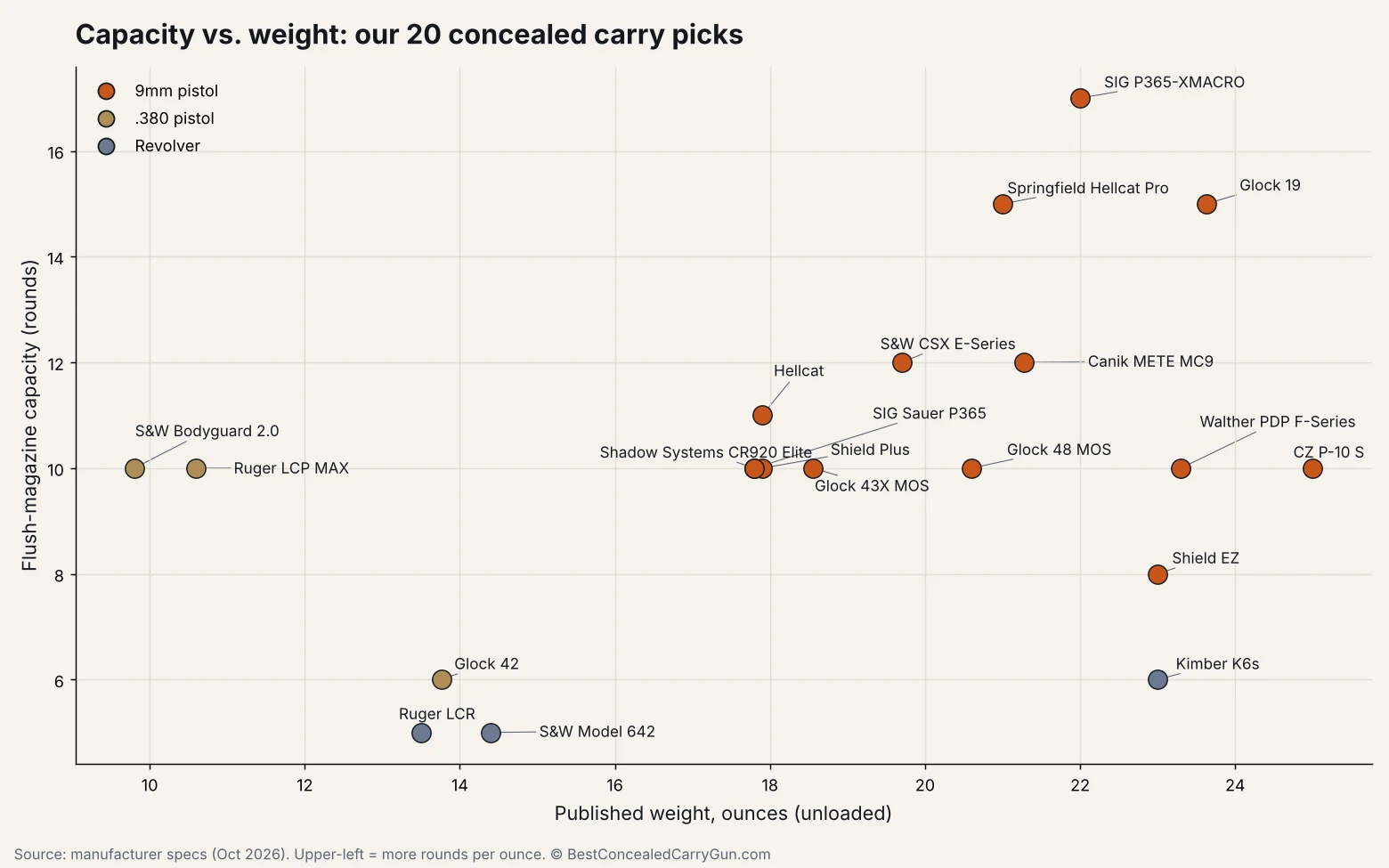
Most rounds per ounce
One quick way to compare how efficiently a pistol packs capacity is rounds per 10 ounces of published weight (flush magazine). It ignores shootability, so read it as one data point, not a ranking.
| # | Pistol | Flush capacity | Weight (oz) | Rounds per 10 oz |
|---|---|---|---|---|
| 1 | S&W Bodyguard 2.0 | 10 | 9.8 | 10.2 |
| 2 | Ruger LCP MAX | 10 | 10.6 | 9.4 |
| 3 | SIG P365-XMACRO | 17 | 22.0 | 7.7 |
| 4 | Springfield Hellcat Pro | 15 | 21.0 | 7.1 |
| 5 | Glock 19 | 15 | 23.63 | 6.3 |
| 6 | Springfield Armory Hellcat | 11 | 17.9 | 6.1 |
| 7 | S&W CSX E-Series | 12 | 19.7 | 6.1 |
| 8 | Canik METE MC9 | 12 | 21.27 | 5.6 |
| 9 | SIG Sauer P365 | 10 | 17.8 | 5.6 |
| 10 | Shadow Systems CR920 Elite | 10 | 17.8 | 5.6 |
How we picked these guns
We started from the guns that consistently appear in instructor recommendations, major independent reviews, and the long-running carry discussions on forums and r/CCW, then filtered them through six questions that matter for daily carry:
- Reliability track record. Has the model been on the market long enough, in large enough numbers, to show how it holds up? Recalls and safety notices count against a gun.
- Concealability. Width, height (grip length is what prints) and weight, taken from the manufacturer’s published specifications.
- Capacity. Flush-magazine capacity, plus the extended magazines most owners actually carry.
- Shootability. Grip length, barrel and sight radius, trigger design and slide effort — the factors that decide whether you can hit under pressure.
- Support. Holsters, magazines, sights and parts. A great gun with no good holster options is a bad carry gun.
- Price and availability in the U.S. as of October 2026.
Every number on this page comes from the manufacturer’s own product page or spec sheet, checked in October 2026 and linked from each gun’s card. Where makers’ pages disagree with each other we say so. We do not invent test data: when our author completes his own range sessions with a gun, we add a clearly labeled hands-on section with the date and round count. Read our full research and review process and editorial policy.
The 20 best concealed carry guns, reviewed
SIG Sauer P365
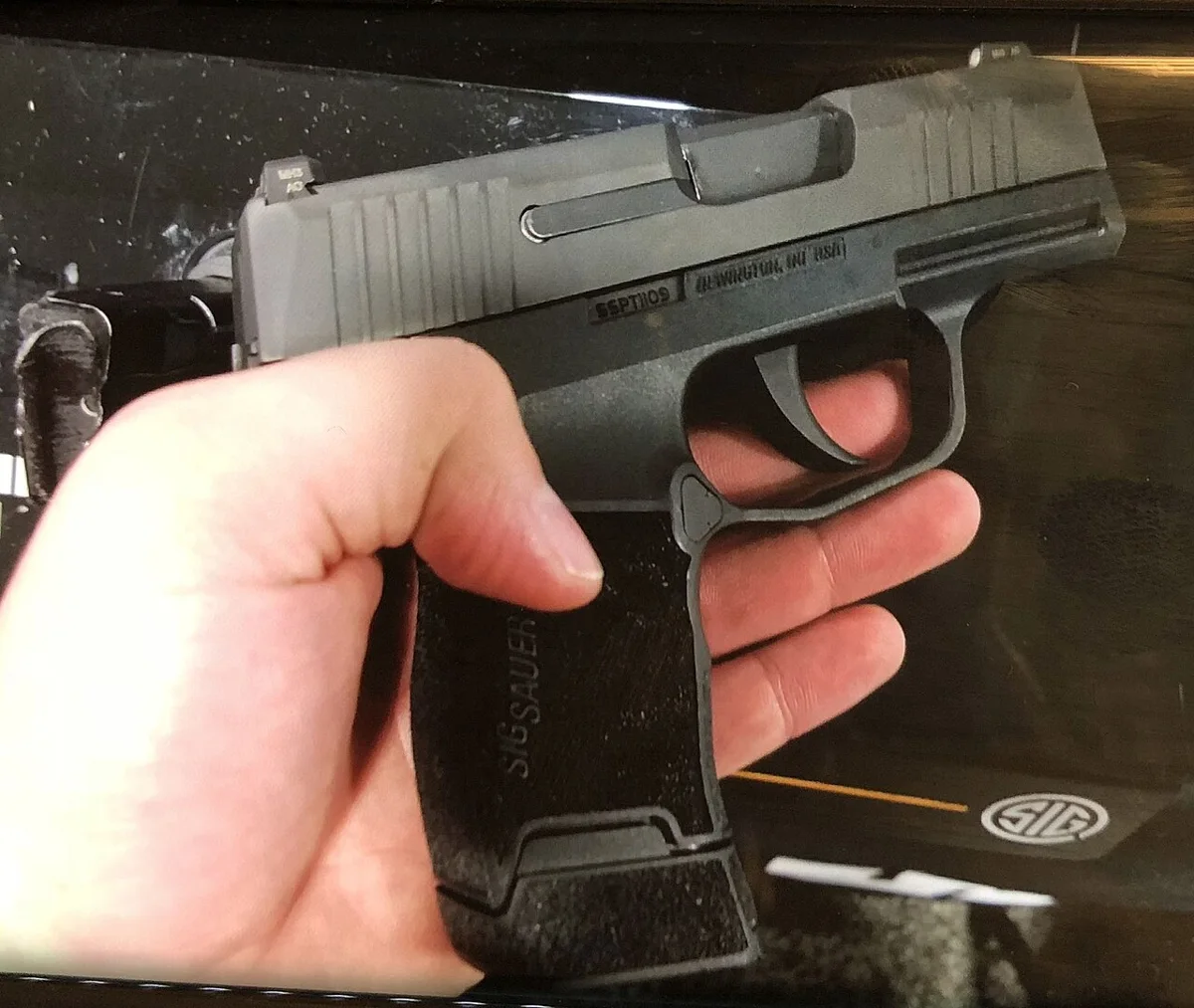
| Caliber | 9mm |
|---|---|
| Capacity | 10 rounds |
| Barrel | 3.1 in |
| Length × height | 5.8 × 4.3 in |
| Width | 1.1 in |
| Weight | 17.8 oz |
| Manual safety | Optional |
| Optics-ready | Some models |
| Price | $500 MSRP |
Why it made our list
If you want one answer to “what’s the best concealed carry gun?”, the P365 is the safest bet we can give. When it launched in 2018 it put ten rounds of 9mm into a pistol the size of a single-stack .380-class gun, and every micro-compact since has been measured against it.
On paper it checks every box that matters for daily carry: about 5.8 inches long, 4.3 inches tall, 1.1 inches wide and 17.8 ounces, with a 10+1 flush magazine (12- and 15-round magazines are sold separately). SIG offers it with or without a manual safety and in optics-ready versions, so the same platform works for a first-time carrier and an experienced shooter who wants a red dot.
The bigger advantage is the ecosystem. The P365 uses a serialized fire-control unit that drops into different grip modules, which means you can grow the same gun into an XL or XMACRO grip later. Holster support is about as broad as it gets for any carry pistol, which matters more than most buyers expect.
Pros
- 10+1 in a true micro-compact footprint
- Manual-safety and optics-ready versions
- Huge holster, magazine and grip-module support
Cons
- Short grip leaves the pinky hanging for larger hands
- Snappier recoil than a compact like the Glock 19
Best for: Most people carrying inside the waistband who want the best mix of size and capacity.
Skip it if: You have large hands and don’t mind a bigger gun — look at the P365-XMACRO or Hellcat Pro.
Springfield Armory Hellcat
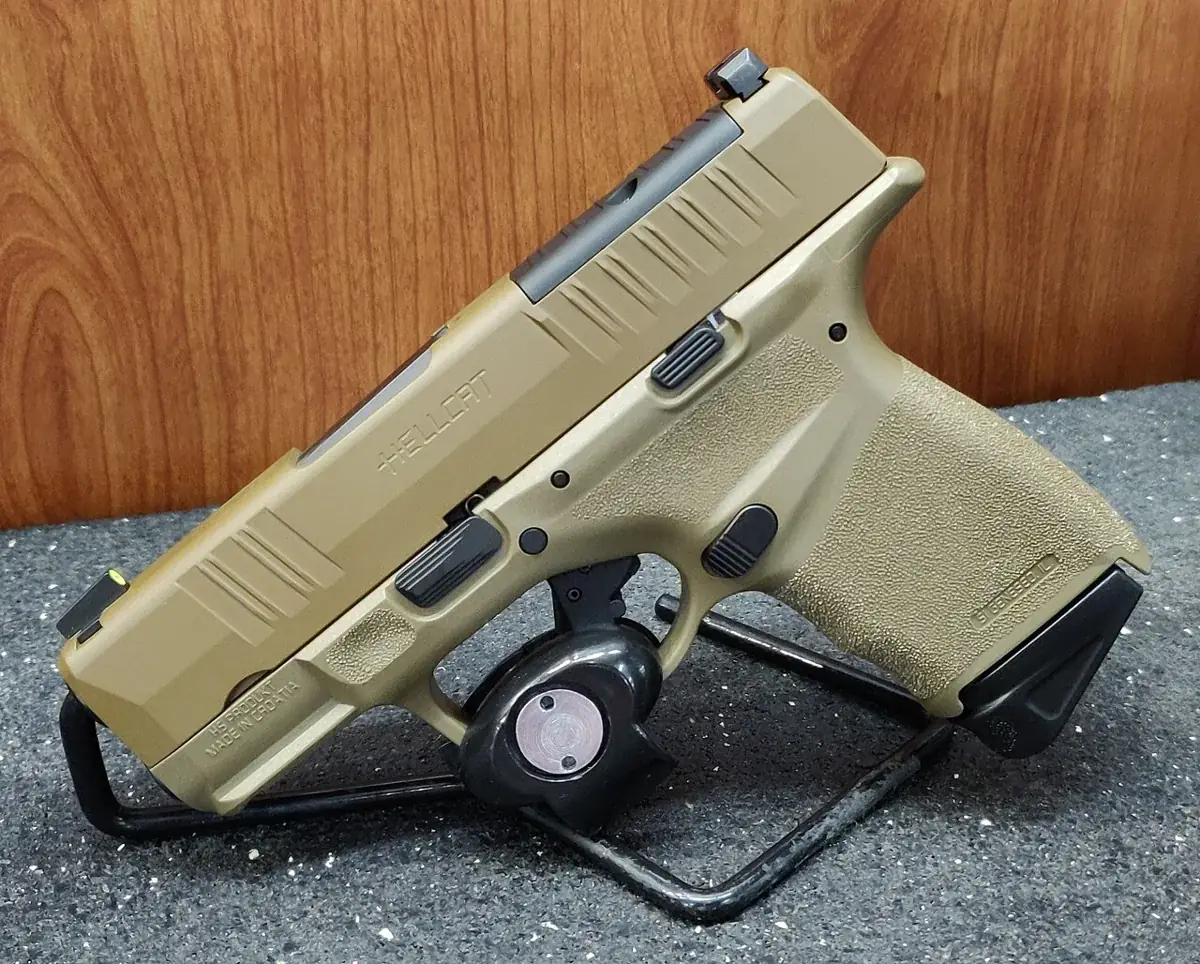
| Caliber | 9mm |
|---|---|
| Capacity | 11/13 rounds |
| Barrel | 3.0 in |
| Length × height | 6.0 × 4.0 in |
| Width | 1.0 in |
| Weight | 17.9 oz |
| Manual safety | No |
| Optics-ready | Yes |
| Price | $653 MSRP |
Why it made our list
The Hellcat answered the P365 with even more capacity: 11+1 with the flush magazine and 13+1 with the extended one, in a grip Springfield lists at 1 inch wide. It weighs about 17.9 ounces and is roughly 6 inches long and 4 inches tall.
Springfield’s current micro-compact Hellcats are all OSP (optics-ready) models, so a slide-mounted micro red dot is part of the plan from day one. The aggressive “adaptive grip texture” keeps it planted in sweaty hands, though some carriers find it rough against bare skin inside the waistband.
Pick the Hellcat over the P365 if every extra round matters to you; pick the P365 if you want the larger accessory ecosystem and a manual-safety option, which Springfield does not currently list for the Hellcat micro-compact.
Pros
- 11+1 flush / 13+1 extended
- Optics-ready across the current line
- Very thin 1-inch grip
Cons
- Grip texture can chafe for IWB carry
- No current manual-safety model
Best for: Carriers who want maximum rounds in the smallest package.
Skip it if: You want a manual safety or a gentler grip texture.
S&W M&P9 Shield Plus
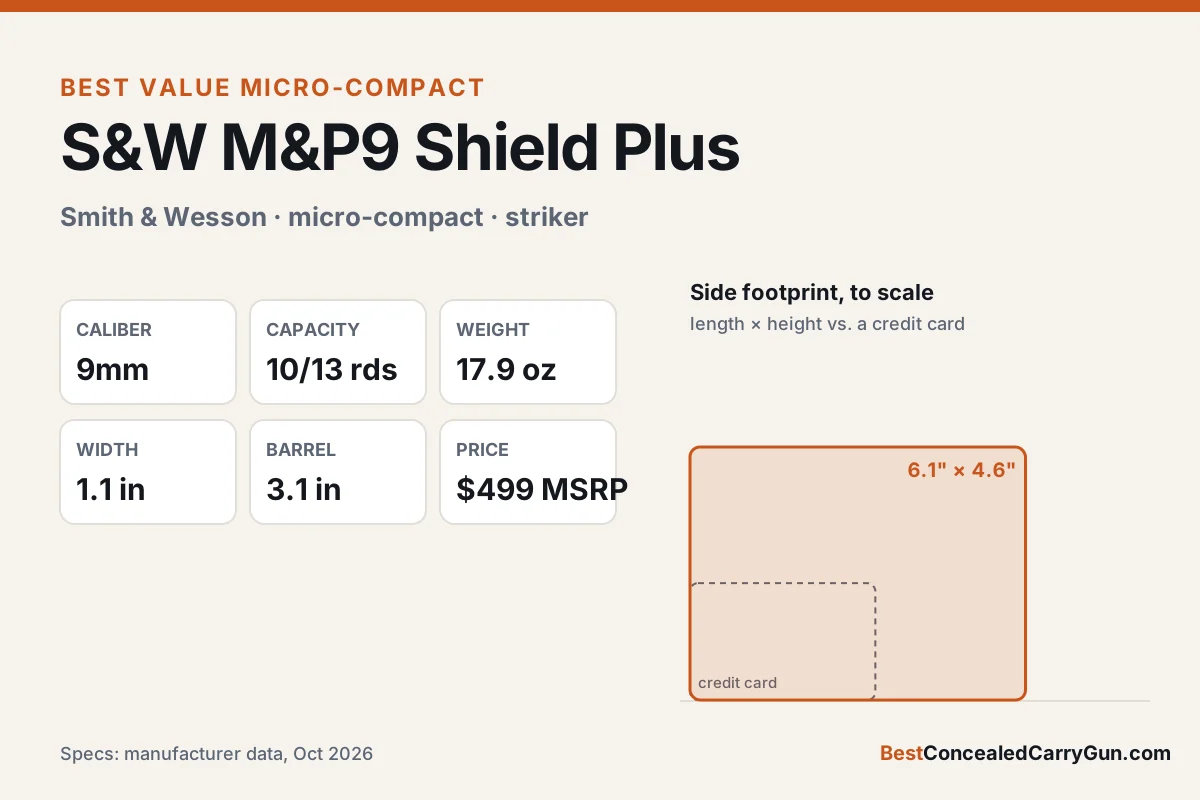
| Caliber | 9mm |
|---|---|
| Capacity | 10/13 rounds |
| Barrel | 3.1 in |
| Length × height | 6.1 × 4.6 in |
| Width | 1.1 in |
| Weight | 17.9 oz |
| Manual safety | Optional |
| Optics-ready | Some models |
| Price | $499 MSRP |
Why it made our list
The Shield Plus took the long-running, widely trusted M&P Shield and gave it the capacity of the new micro-compacts: a 10-round flush magazine and a 13-round extended magazine, in a frame S&W lists at 1.1 inches wide. It weighs about 17.9 ounces with a 3.1-inch barrel.
At a $499 MSRP it undercuts most of its direct competitors, and it is one of the few in this class sold both with and without a thumb safety. The flat-face trigger is a real upgrade over the original Shield, and the optics-ready model (with night sights) lists at $549.
It is not the flashiest gun on this list — it is the one we’d point a budget-minded buyer toward when they want a proven name, real capacity and holster options at every price.
Pros
- Lower price than most micro-compact rivals
- Thumb-safety and no-safety versions
- 10/13-round magazines in a thin frame
Cons
- Optics-ready version costs extra
- Fewer factory grip options than the P365
Best for: First-time buyers who want a mainstream micro-compact without paying a premium.
Skip it if: You want an optic from the start — compare the optics-ready Hellcat or MAX-9.
Glock 43X MOS
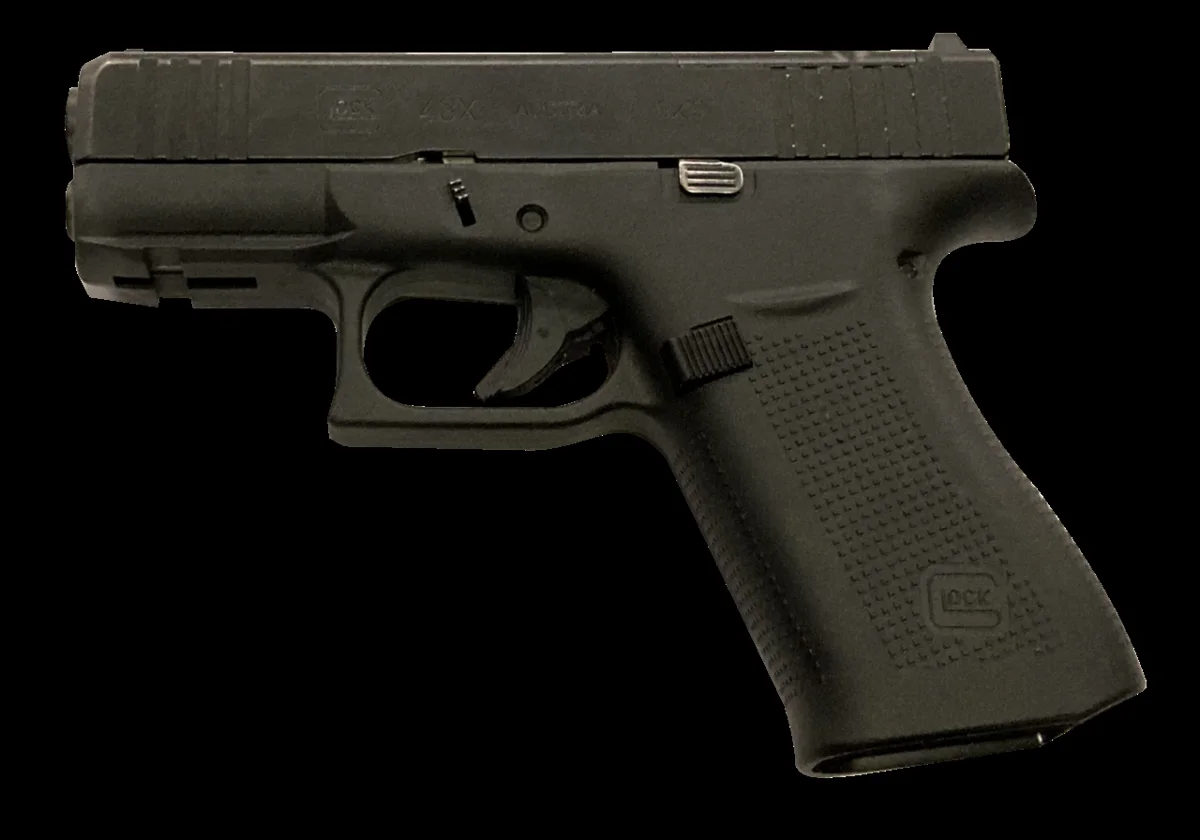
| Caliber | 9mm |
|---|---|
| Capacity | 10 rounds |
| Barrel | 3.41 in |
| Length × height | 6.5 × 5.04 in |
| Width | 1.1 in |
| Weight | 18.55 oz |
| Manual safety | No |
| Optics-ready | Yes |
| Price | $484 street |
Why it made our list
The 43X pairs a slim 1.10-inch “Slimline” frame with a 10-round magazine and a grip long enough for a full firing grip on most hands. The MOS version adds a factory optic cut. Unloaded with an empty magazine it weighs about 18.6 ounces.
What you’re really buying is Glock’s simplicity: no manual safety, a consistent trigger, few parts, and the largest aftermarket in the handgun world. Holster makers support it heavily, and aftermarket higher-capacity magazines exist if ten rounds isn’t enough (we recommend testing any non-factory magazine thoroughly before carrying it).
Against the P365 and Hellcat it gives up a little capacity in a slightly taller gun, but many shooters find the longer grip and soft recoil easier to shoot well.
Pros
- Simple, proven Glock action
- Long grip for its width
- MOS optic cut; massive aftermarket
Cons
- Only 10 rounds with factory magazines
- Taller than the P365 or Hellcat
Best for: Glock fans and anyone who values simplicity over the last few rounds of capacity.
Skip it if: You need a manual safety — Glock doesn’t offer one on the 43X.
SIG P365-XMACRO
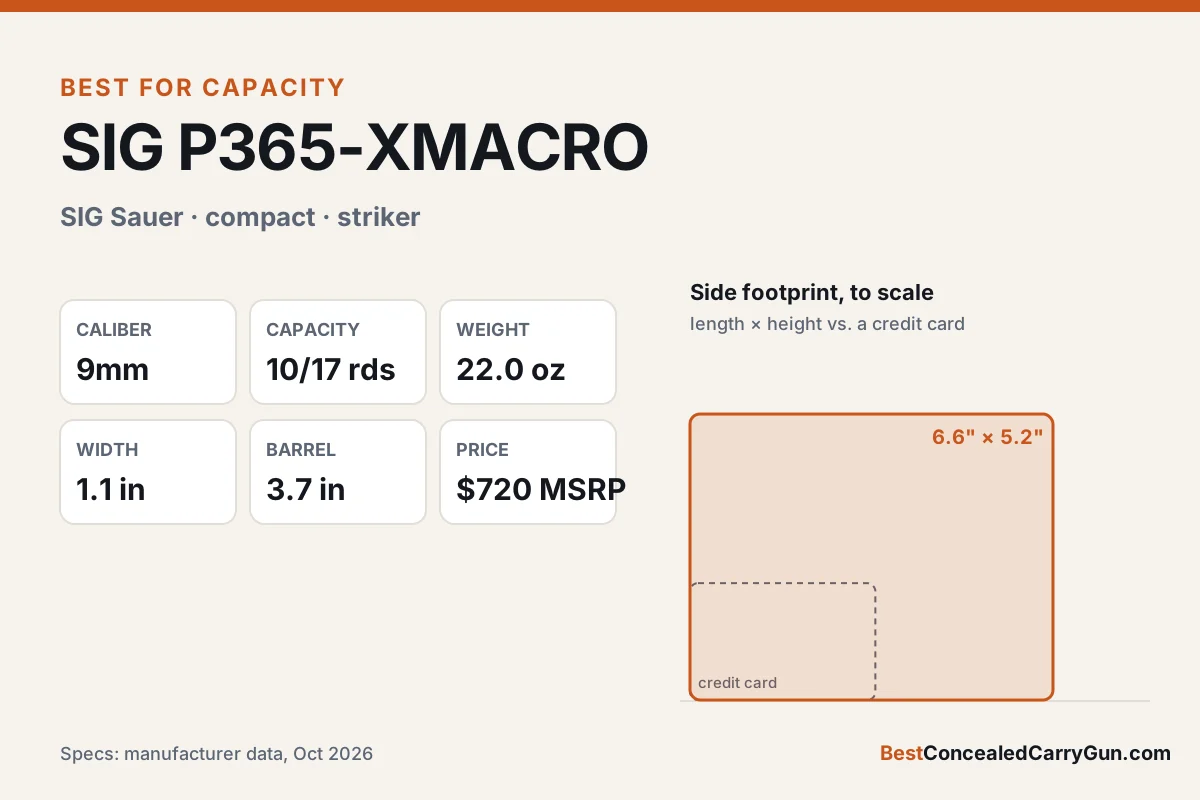
| Caliber | 9mm |
|---|---|
| Capacity | 10/17 rounds |
| Barrel | 3.7 in |
| Length × height | 6.6 × 5.2 in |
| Width | 1.1 in |
| Weight | 22.0 oz |
| Manual safety | Optional |
| Optics-ready | Yes |
| Price | $720 MSRP |
Why it made our list
The XMACRO keeps the P365’s 1.1-inch width but stretches the grip to hold a flush 17-round magazine — compact-pistol capacity in a carry-width frame. SIG lists it at 6.6 inches long, 5.2 inches tall and 22 ounces with the 3.7-inch barrel.
Every XMACRO SKU SIG lists is optics-ready, and there is a COMP version with a 3.1-inch barrel and integrated compensator. The longer grip is the trade-off: it is easier to shoot and hold, but the grip is what prints, so belt and holster choice matter more than with the standard P365.
If you want one gun that can carry daily and also work as a home-defense or training pistol, this is the one on our list that does both with the least compromise.
Pros
- 17+1 flush in a 1.1-inch-wide frame
- Optics-ready on every SKU
- Shoots like a compact
Cons
- Longer grip prints more
- Pricier than the standard P365
Best for: Experienced carriers who want maximum capacity and shootability.
Skip it if: You carry in shorts and T-shirts most of the year — the standard P365 hides more easily.
Glock 19
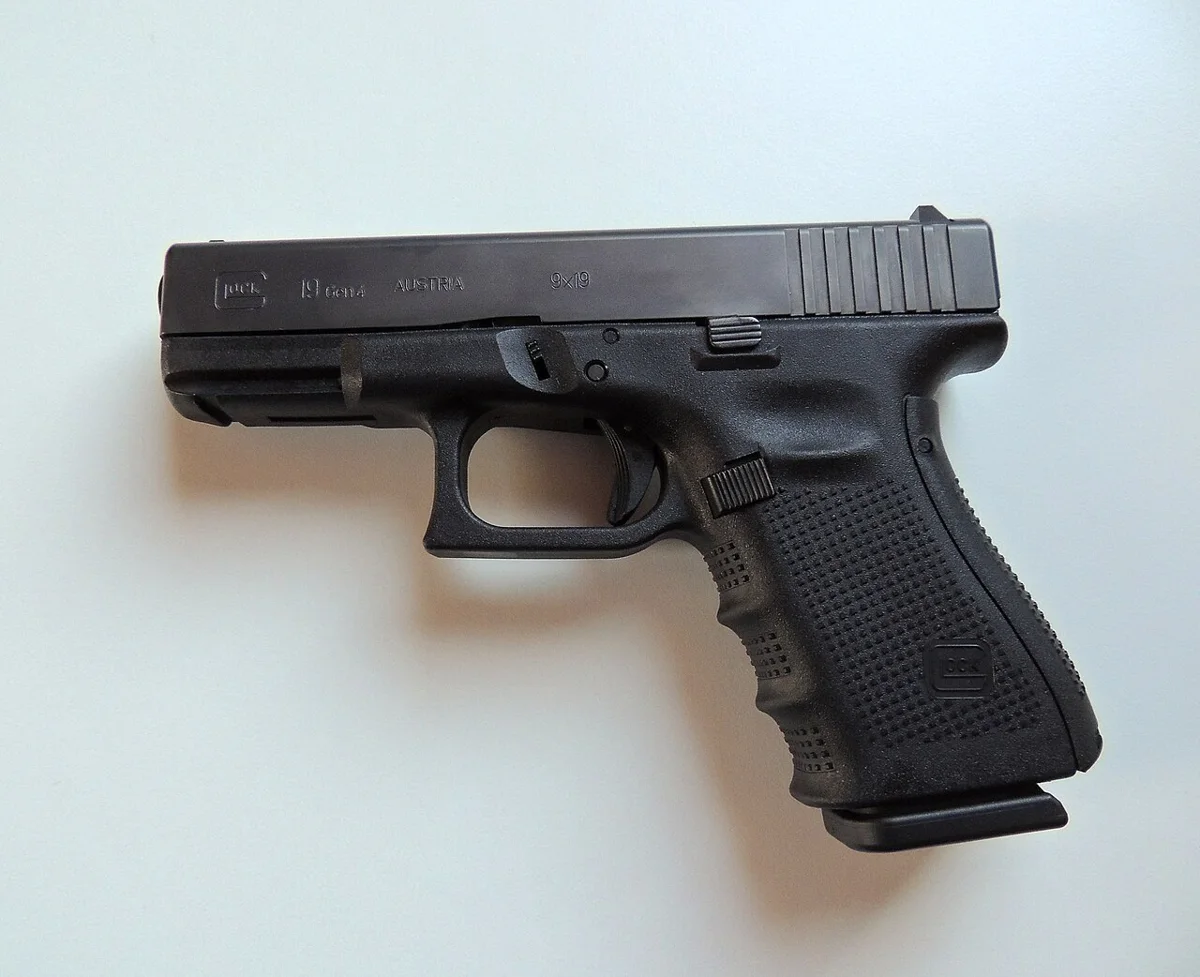
| Caliber | 9mm |
|---|---|
| Capacity | 15 rounds |
| Barrel | 4.02 in |
| Length × height | 7.28 × 5.04 in |
| Width | 1.34 in |
| Weight | 23.63 oz |
| Manual safety | No |
| Optics-ready | Some models |
| Price | $539 street |
Why it made our list
The Glock 19 is the benchmark compact 9mm: 15+1, a 4-inch barrel, and a size that works for concealed carry, home defense and the range. Glock replaced the Gen5 G19 with the G19 V in late 2025 and added an optics-ready G19 Gen6 in January 2026 — check which version you are buying, because holster fit can differ between generations.
At 1.34 inches wide and about 23.6 ounces with an empty magazine it is noticeably bigger than the micro-compacts above, and that size is exactly why it is easier to shoot well. Many instructors still suggest it as the do-everything first handgun.
Carry it in a good IWB holster with a stiff gun belt and it hides better than you’d expect; if you need deep concealment, look to the 43X or P365 instead.
Pros
- 15+1 and a full firing grip
- Easy to shoot accurately
- Unmatched holster and parts support
Cons
- Thicker and heavier than micro-compacts
- Generational changes complicate holster fit
Best for: One-gun owners who want carry, home defense and range use from a single pistol.
Skip it if: You need deep concealment in light clothing.
Glock 48 MOS
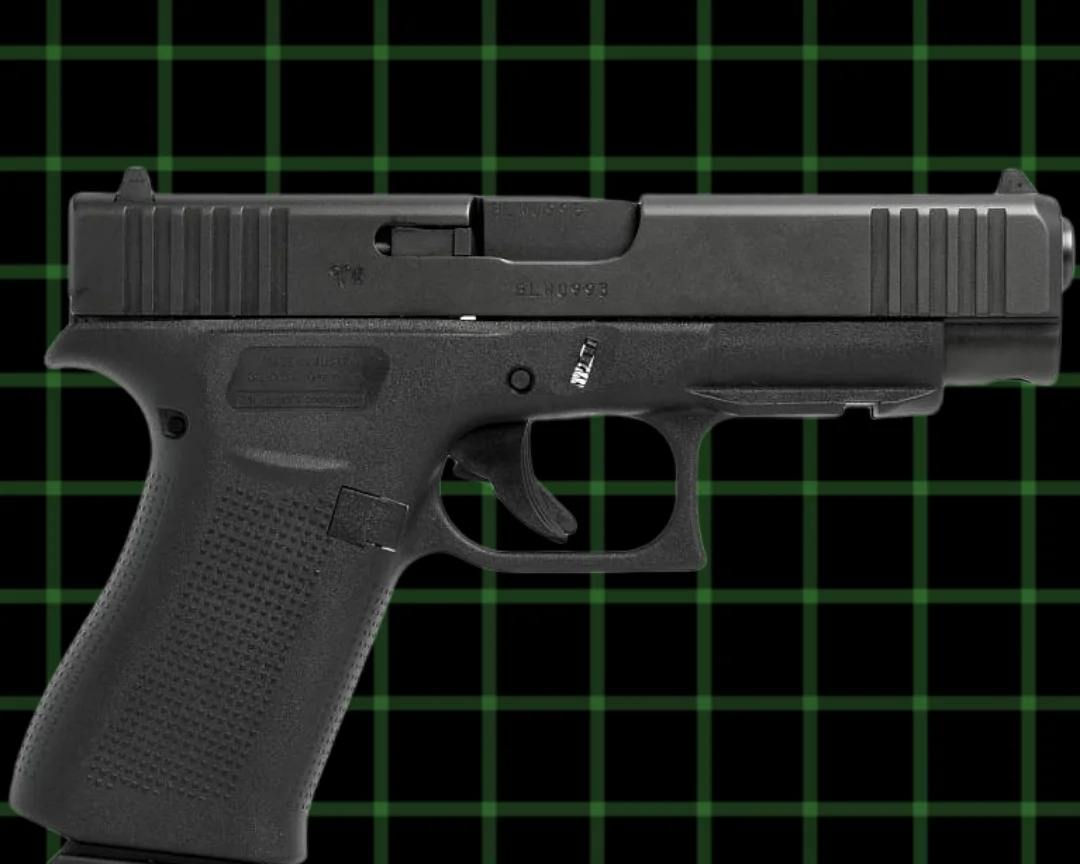
| Caliber | 9mm |
|---|---|
| Capacity | 10 rounds |
| Barrel | 4.17 in |
| Length × height | 7.28 × 5.04 in |
| Width | 1.1 in |
| Weight | 20.6 oz |
| Manual safety | No |
| Optics-ready | Yes |
| Price | $484 street |
Why it made our list
The Glock 48 takes a G19-length slide and height and puts it on the 1.10-inch Slimline frame. The longer sight radius and 4.17-inch barrel make it easier to shoot than shorter micro-compacts, while the slim grip still conceals well. It weighs about 20.6 ounces with an empty magazine.
Factory capacity is 10 rounds, the same as the 43X. The MOS version adds an optic cut. Like every Glock, it has no manual safety option.
Choose the 48 over the 43X if you carry appendix or strong-side with a good holster and want more barrel and slide for the same grip.
Pros
- Slim 1.10-inch frame
- Long slide for easier accuracy
- MOS optic cut
Cons
- 10 rounds with factory magazines
- Longer slide can be harder to sit with
Best for: Carriers who want a slim gun that shoots like a compact.
Skip it if: You mostly pocket or ankle carry.
Walther PDP F-Series
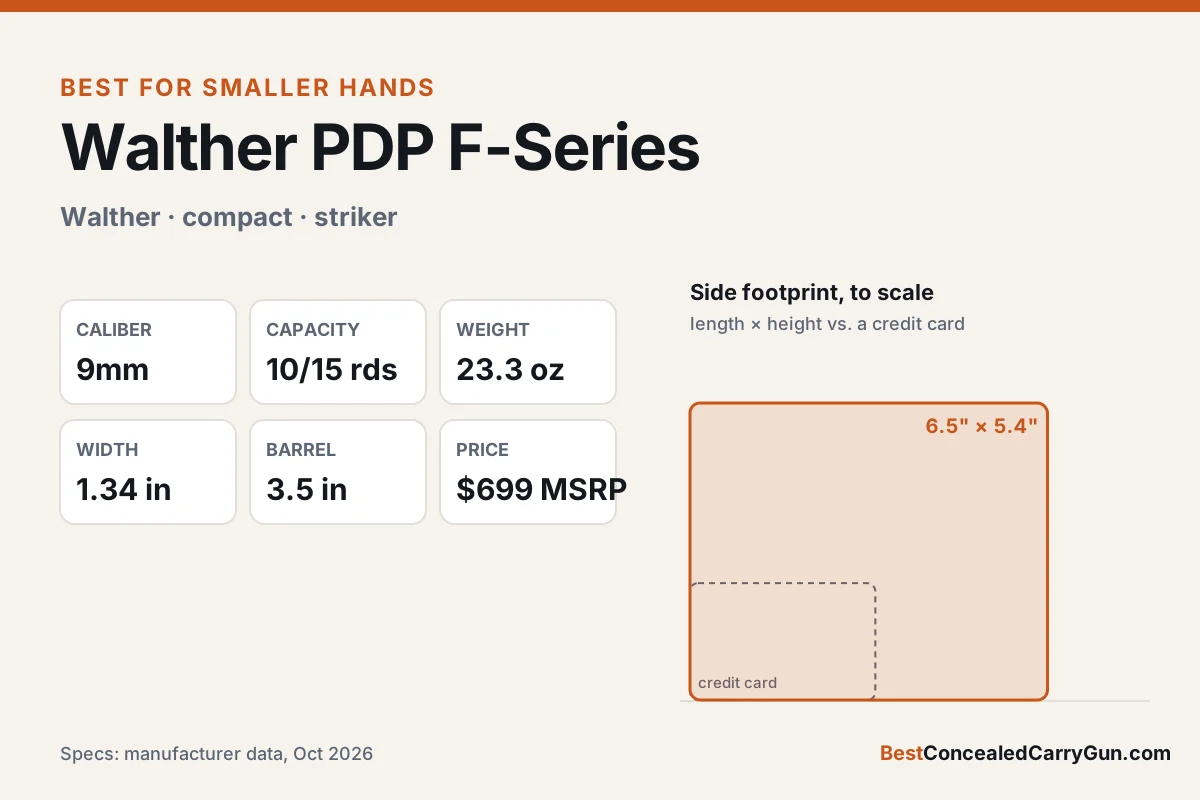
| Caliber | 9mm |
|---|---|
| Capacity | 10/15 rounds |
| Barrel | 3.5 in |
| Length × height | 6.5 × 5.4 in |
| Width | 1.34 in |
| Weight | 23.3 oz |
| Manual safety | No |
| Optics-ready | Yes |
| Price | $699 MSRP |
Why it made our list
Walther designed the PDP F-Series around smaller hands: a reduced-circumference grip, a shorter trigger reach, and a two-piece striker that Walther says reduces slide-rack force by about 20 percent. The 3.5-inch model holds 15+1 and weighs about 23.3 ounces.
It is a compact rather than a micro-compact, so it is not the smallest gun here — but for shooters who struggle to reach the trigger correctly or rack a slide on other guns, fit matters more than an extra fraction of an inch.
The PDP’s optics-ready slide uses Walther’s plate system and its trigger is one of the best-regarded factory striker triggers available.
Pros
- Grip and trigger reach sized for smaller hands
- Easier slide manipulation
- 15+1 capacity
Cons
- Larger than micro-compacts
- Optic plates sold separately
Best for: Shooters with smaller hands, including many women, who want a full-capacity compact.
Skip it if: Your priority is deep concealment.
S&W M&P9 Shield EZ
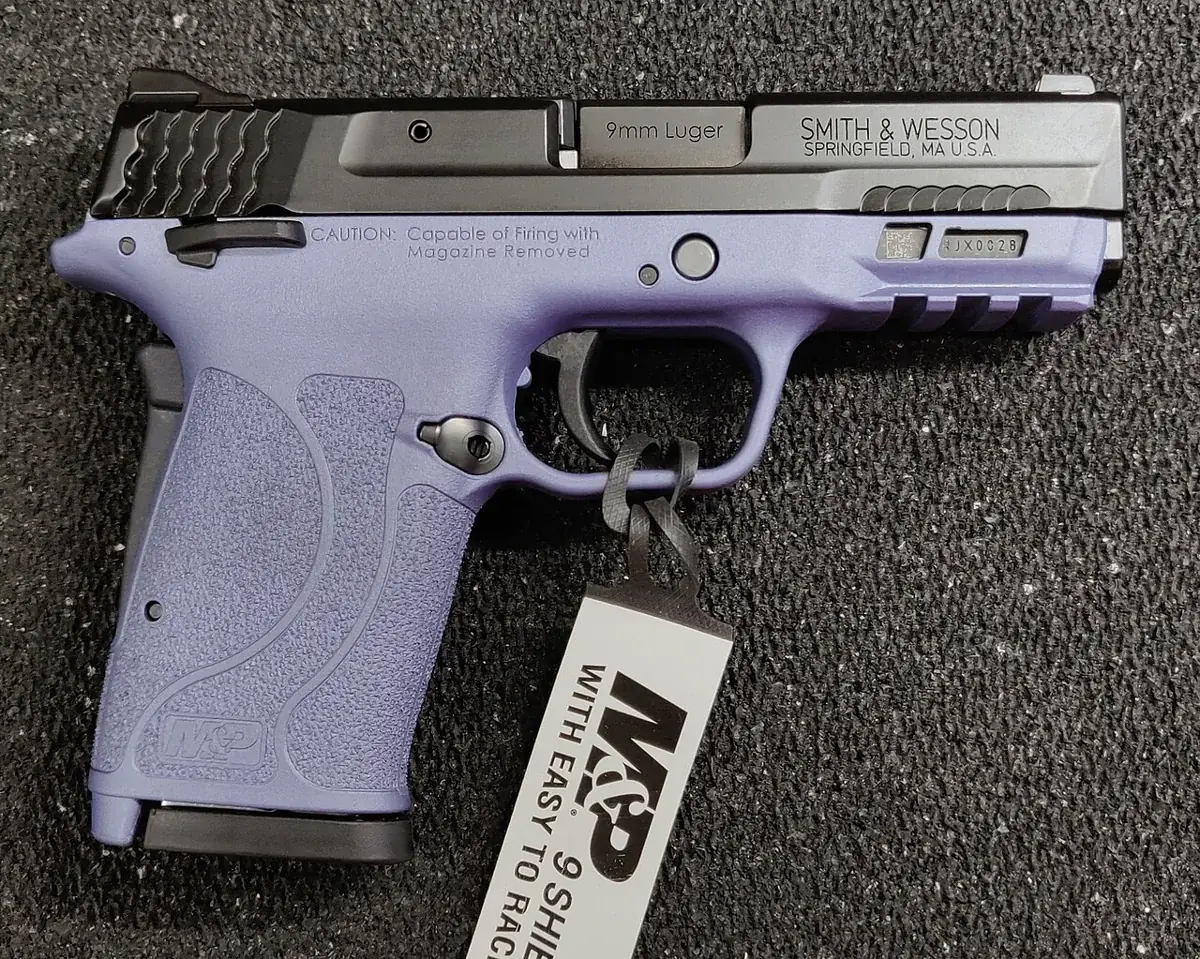
| Caliber | 9mm |
|---|---|
| Capacity | 8 rounds |
| Barrel | 3.675 in |
| Length × height | 6.8 × 5.05 in |
| Width | 1.04 in |
| Weight | 23.0 oz |
| Manual safety | Optional |
| Optics-ready | No |
| Price | $539 MSRP |
Why it made our list
The Shield EZ solves the problem that sends many new shooters back to the gun counter: a slide that is hard to rack. Its easy-to-rack slide, internal hammer and grip safety make it one of the most approachable carry guns for new shooters, people with reduced hand strength, and older carriers.
It holds 8+1 rounds of 9mm in a 1.04-inch-wide frame and weighs about 23 ounces, so it is heavier and lower capacity than the micro-compacts — but that weight also soaks up recoil. It is also made in .380 ACP and .30 Super Carry.
If you have ever handed a friend a pistol and watched them fight the slide, this is the gun to put in their hands next.
Pros
- Very easy to rack and load
- Grip safety plus optional thumb safety
- Mild recoil for a carry gun
Cons
- 8+1 capacity
- Heavier than micro-compacts
Best for: New shooters and anyone with limited hand strength.
Skip it if: You already shoot well and want maximum capacity.
Canik METE MC9
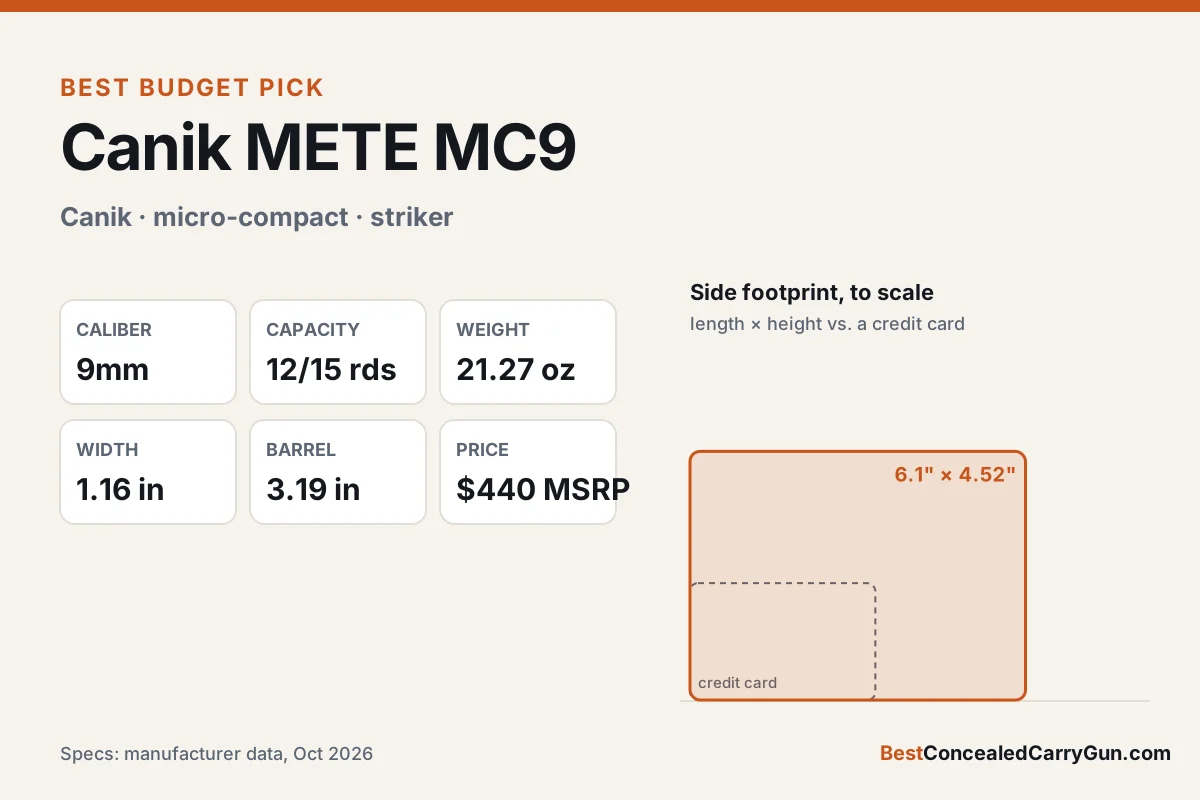
| Caliber | 9mm |
|---|---|
| Capacity | 12/15 rounds |
| Barrel | 3.19 in |
| Length × height | 6.1 × 4.52 in |
| Width | 1.16 in |
| Weight | 21.27 oz |
| Manual safety | No |
| Optics-ready | Yes |
| Price | $440 MSRP |
Why it made our list
Canik’s METE MC9 comes in the box with 12- and 15-round magazines, three backstraps and a holster, and its slide is optics-ready — at a $439.99 MSRP. That is a lot of gun for the money.
It is about 6.1 inches long, 4.52 inches tall and 1.16 inches wide, and weighs about 21.3 ounces — a little heavier than the class leaders, which helps it shoot softly. Canik’s triggers have a strong reputation among value-focused shooters.
Budget guns live or die on support, so check holster availability for the MC9 before you buy; it’s good and improving but not at P365 or Glock levels yet.
Pros
- Two magazines, backstraps and holster included
- Optics-ready slide
- Low MSRP for the feature set
Cons
- Heavier than the top micro-compacts
- Smaller holster selection
Best for: Buyers on a tight budget who still want an optics-ready, high-capacity carry gun.
Skip it if: You need the widest choice of premium holsters and accessories.
Ruger LCP MAX
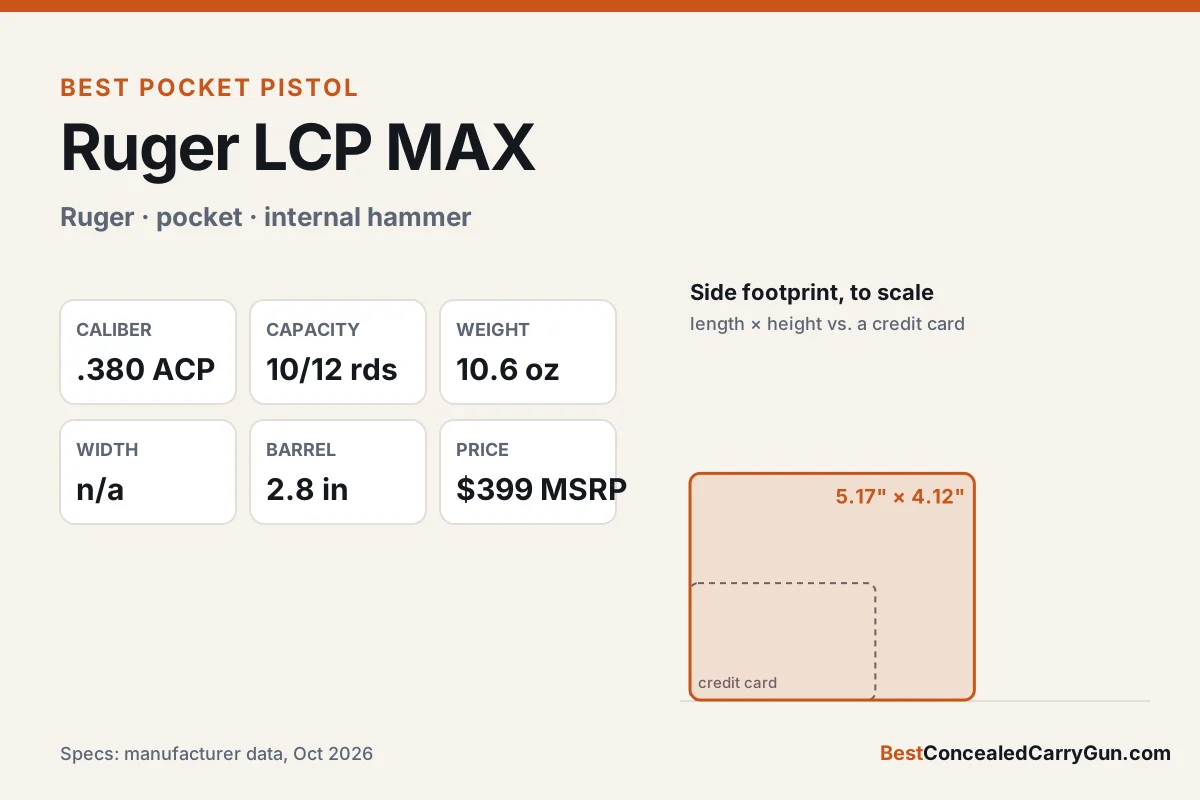
| Caliber | .380 ACP |
|---|---|
| Capacity | 10/12 rounds |
| Barrel | 2.8 in |
| Length × height | 5.17 × 4.12 in |
| Width | not listed |
| Weight | 10.6 oz |
| Manual safety | Optional |
| Optics-ready | Some models |
| Price | $399 MSRP |
Why it made our list
When a gun has to disappear in a front pocket, the LCP MAX is the standard we’d start with. Ruger fit a 10+1 .380 ACP magazine into essentially the LCP II footprint, at about 10.6 ounces and 5.17 inches long. Twelve-round magazines are available, and the LCP MAX Pro model carries 13+1.
Pocket .380s are harder to shoot well than larger 9mms — the grip is short and the sights are small — so treat this as a deep-concealment or backup gun and practice more, not less.
Ruger lists a safety bulletin for certain LCP MAX manual-safety models; if you buy one with a manual safety, check Ruger’s site for the current notice.
Pros
- 10+1 .380 in a true pocket size
- About 10.6 ounces
- 12-round magazines and a 13+1 Pro model
Cons
- .380 ACP is less powerful than 9mm
- Short grip and small sights
Best for: Pocket carry, dress clothes, and backup-gun use.
Skip it if: It will be your only gun and you can carry something bigger.
S&W Bodyguard 2.0
| Caliber | .380 ACP |
|---|---|
| Capacity | 10/12 rounds |
| Barrel | 2.75 in |
| Length × height | 5.5 × 4.0 in |
| Width | 0.875 in |
| Weight | 9.8 oz |
| Manual safety | Optional |
| Optics-ready | No |
| Price | $449 MSRP |
Why it made our list
S&W’s Bodyguard 2.0 rethinks the original Bodyguard 380 as a striker-fired gun with 10+1 (flush) or 12+1 (extended) capacity, a tritium front sight, and a width of just 7/8 inch. At 9.8 ounces it is the lightest gun on our list.
Like every pocket .380, it rewards practice. If you are choosing between it and the LCP MAX, hold both — small differences in grip shape decide which one shoots better for you.
Pros
- 9.8 oz and 7/8-inch wide
- 10/12-round capacity
- Tritium front sight
Cons
- Small gun, snappy recoil
- Not optics-ready
Best for: Ultralight pocket carry.
Skip it if: You can carry a micro-compact 9mm instead.
Glock 42
| Caliber | .380 ACP |
|---|---|
| Capacity | 6 rounds |
| Barrel | 3.25 in |
| Length × height | 5.94 × 4.13 in |
| Width | 0.98 in |
| Weight | 13.76 oz |
| Manual safety | No |
| Optics-ready | No |
| Price | $399 street |
Why it made our list
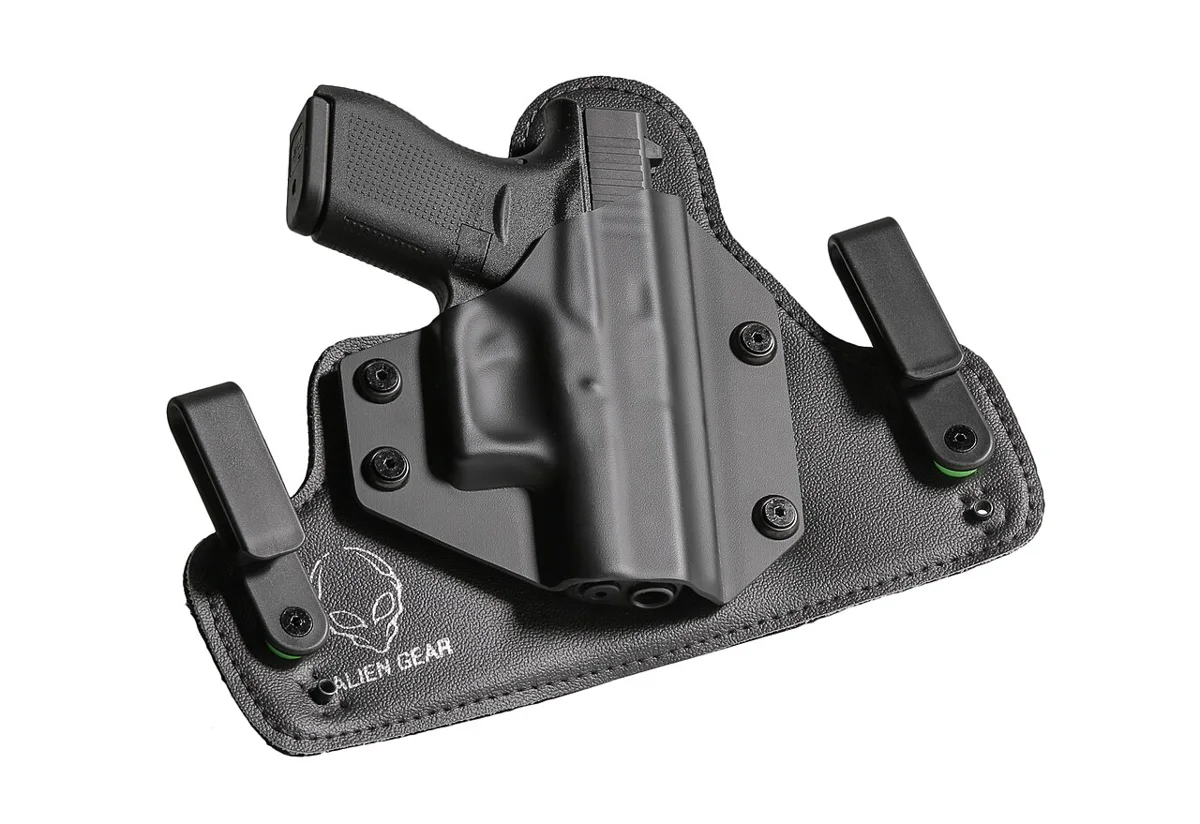
The Glock 42 is slightly larger than the pocket .380s — 5.94 inches long and 0.98 inch wide — and that extra size makes it one of the more pleasant .380s to shoot. Capacity is a modest 6+1.
It suits shooters who are sensitive to recoil and want Glock’s simple action in a small, light package (about 13.8 ounces with an empty magazine).
Pros
- Mild recoil for a .380
- Simple Glock action
- Slim 0.98-inch width
Cons
- Only 6+1
- Larger than true pocket .380s
Best for: Recoil-sensitive shooters who want a small, simple gun.
Skip it if: Capacity matters to you — the LCP MAX and Bodyguard 2.0 carry 10+1.
Ruger LCR (.38 Special +P)
| Caliber | .38 Special +P |
|---|---|
| Capacity | 5 rounds |
| Barrel | 1.87 in |
| Length × height | 6.5 × 4.5 in |
| Width | not listed |
| Weight | 13.5 oz |
| Manual safety | No |
| Optics-ready | No |
| Price | $759 MSRP |
Why it made our list
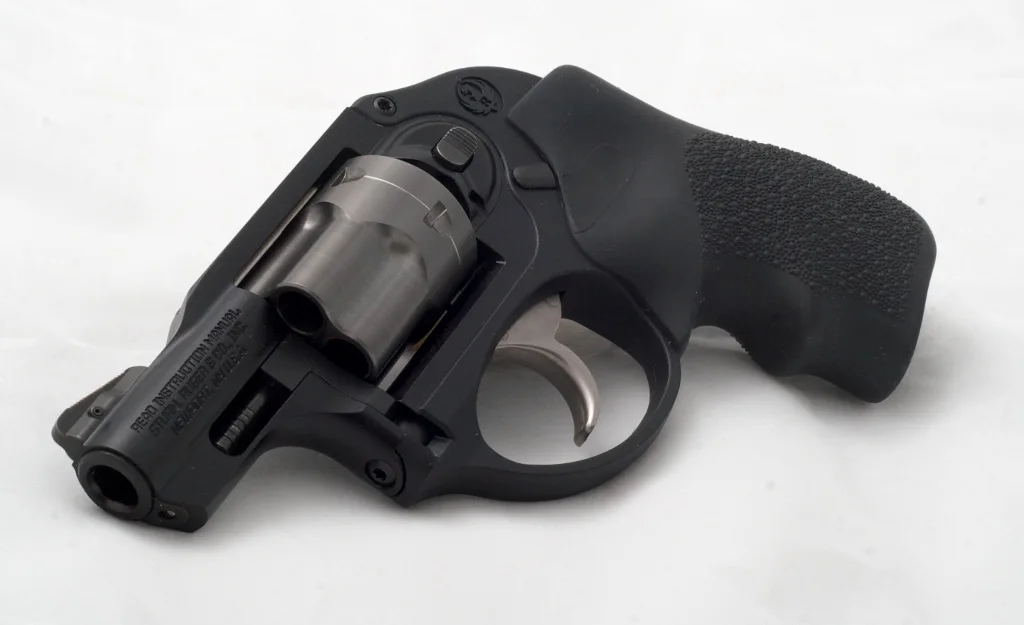
If you prefer a revolver, the LCR is the modern choice: a 13.5-ounce, five-shot .38 Special +P with an aluminum frame, a polymer fire-control housing, and Ruger’s friction-reducing cam that gives it a smooth, non-stacking double-action pull.
Revolvers are simple to operate and forgiving of ammunition, but they hold five rounds and reload slowly. Availability varies by model — at our last check Ruger listed the standard LCR (5401) as currently unavailable and the fiber-optic model (5418) as limited.
Pros
- 13.5 oz
- Smooth double-action trigger
- Simple, ammo-tolerant revolver
Cons
- 5 rounds; slow reloads
- Lightweight snub = stout recoil
Best for: Revolver fans and pocket or off-body carriers.
Skip it if: You want capacity and fast reloads.
S&W Model 642
| Caliber | .38 Special +P |
|---|---|
| Capacity | 5 rounds |
| Barrel | 1.88 in |
| Length × height | 6.31 × 4.3 in |
| Width | 1.3 in |
| Weight | 14.4 oz |
| Manual safety | No |
| Optics-ready | No |
| Price | $569 MSRP |
Why it made our list
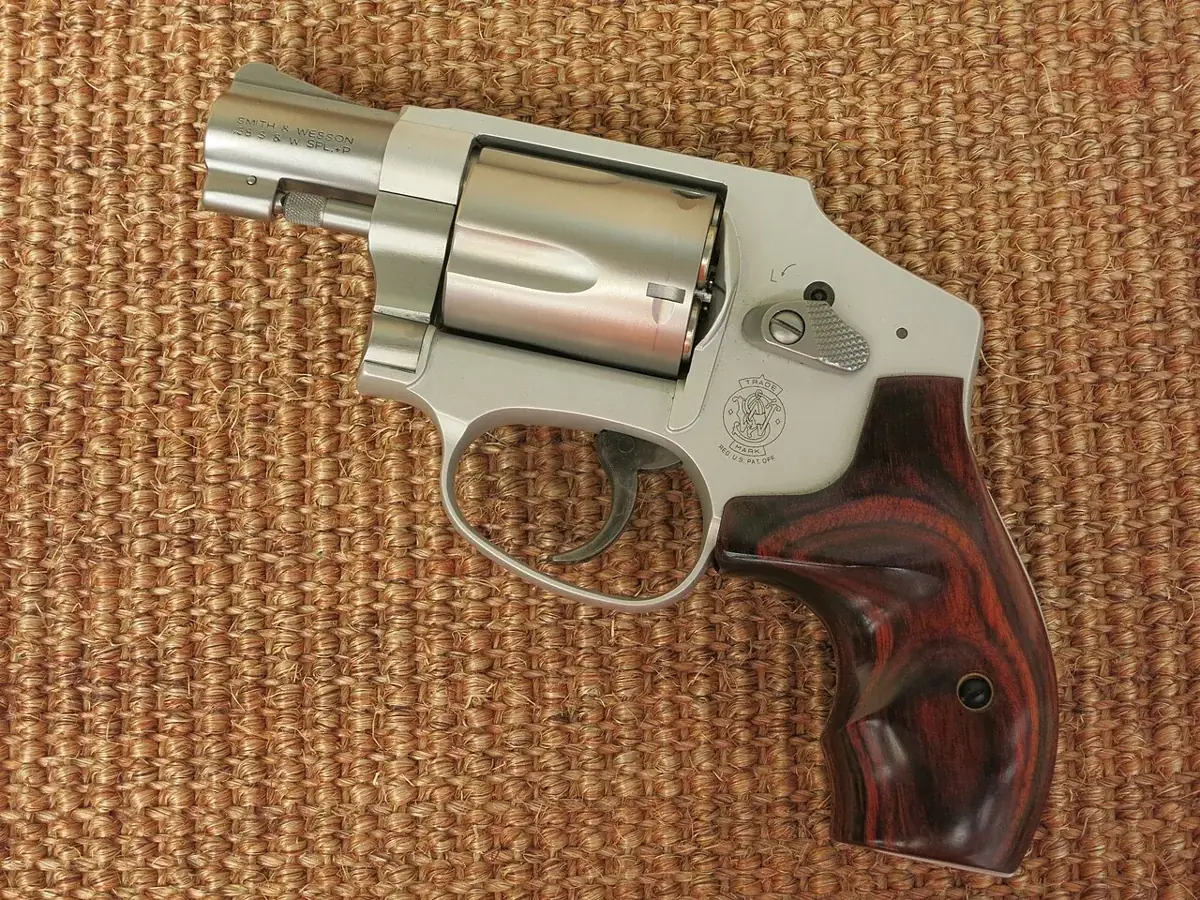
The 642 is the enclosed-hammer Airweight J-frame that generations of carriers have relied on. It holds five rounds of .38 Special +P, weighs about 14.4 ounces, and the hammerless design keeps it from snagging when drawn from a pocket.
S&W sells it without the internal lock that many buyers dislike. Expect a heavier double-action trigger than the LCR, and plan to practice with it.
Pros
- Snag-free enclosed hammer
- About 14.4 oz
- Sold without internal lock
Cons
- 5 rounds
- Heavier trigger than the LCR
Best for: Pocket carry and backup use by revolver traditionalists.
Skip it if: You need more than five rounds.
Kimber K6s
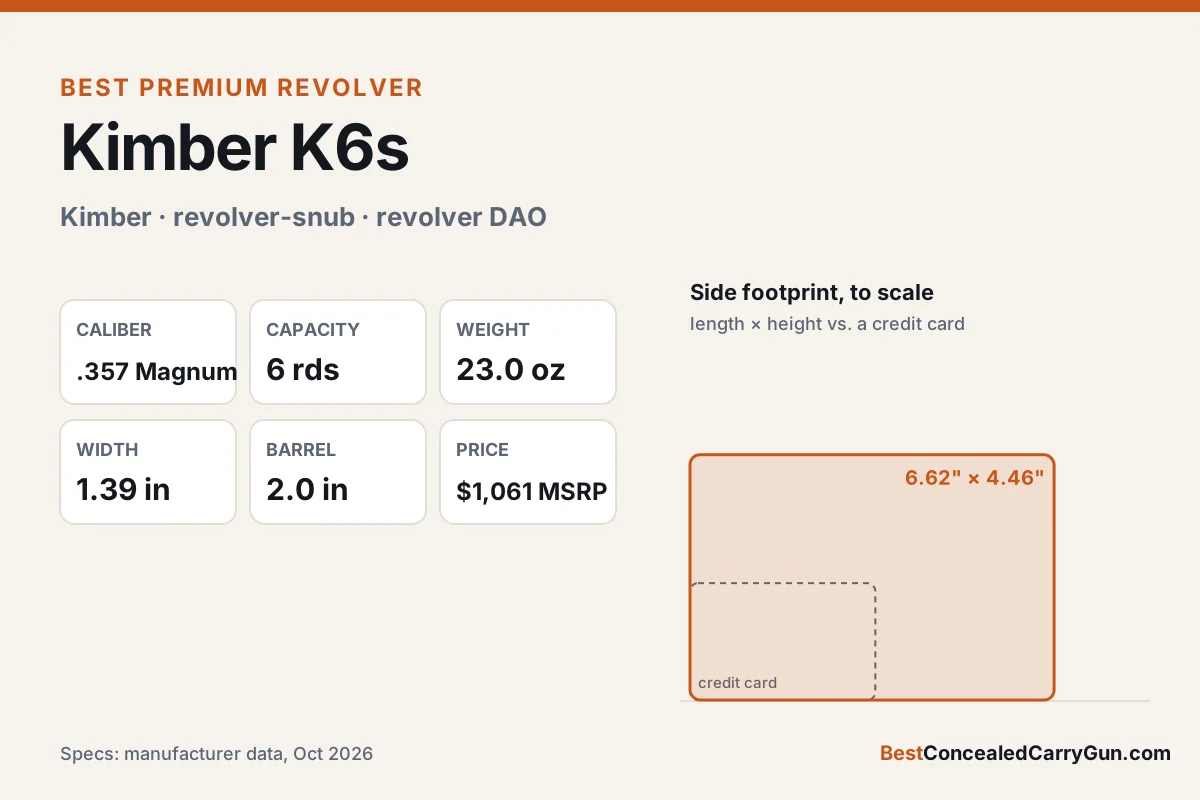
| Caliber | .357 Magnum |
|---|---|
| Capacity | 6 rounds |
| Barrel | 2.0 in |
| Length × height | 6.62 × 4.46 in |
| Width | 1.39 in |
| Weight | 23.0 oz |
| Manual safety | No |
| Optics-ready | No |
| Price | $1,061 MSRP |
Why it made our list
The K6s fits six rounds of .357 Magnum into a stainless snub revolver weighing about 23 ounces — one more round than most J-frame-size revolvers. It also fires .38 Special, which most owners will carry and practice with.
It is expensive (about $1,061 MSRP, often less at retail), but if you want a premium carry revolver with a sixth round, it is the one to look at.
Pros
- Six rounds of .357 Magnum
- Stainless steel
- Enclosed-hammer DAO
Cons
- High price
- Heavier than aluminum snubs
Best for: Revolver carriers who want one more round and a premium finish.
Skip it if: Budget is a concern.
Shadow Systems CR920 Elite
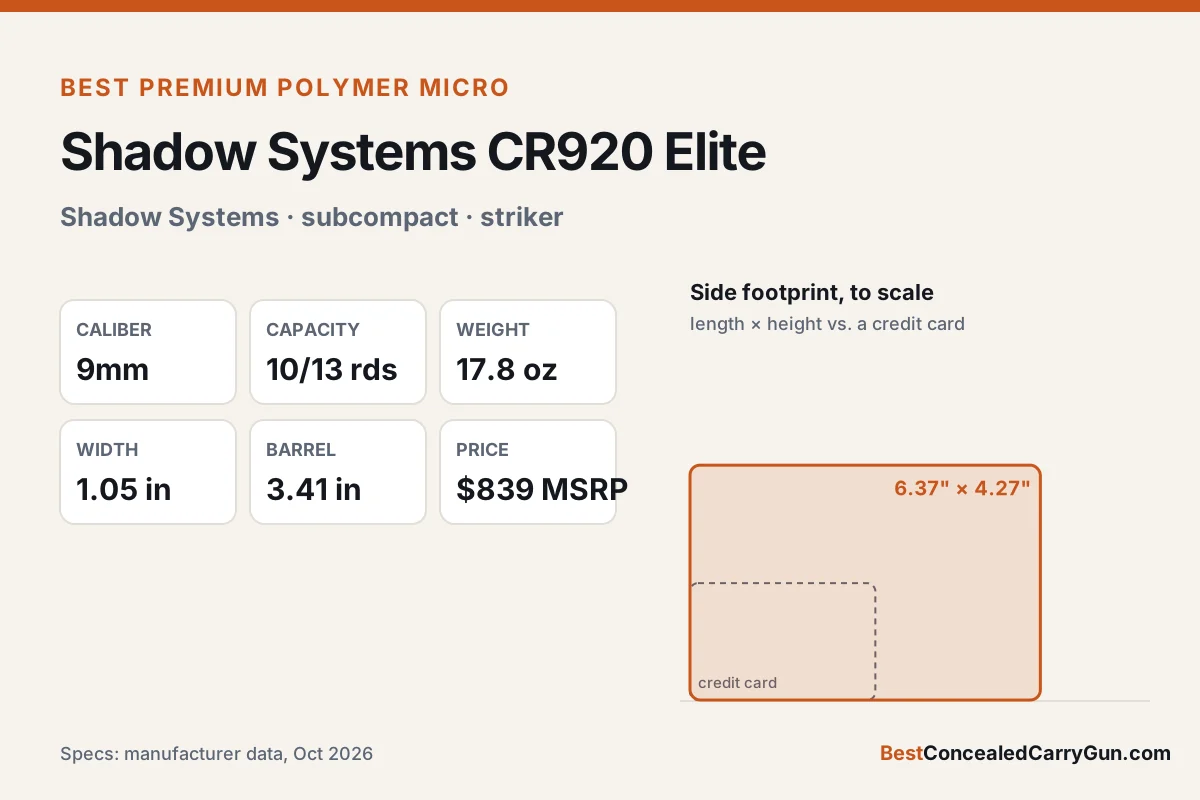
| Caliber | 9mm |
|---|---|
| Capacity | 10/13 rounds |
| Barrel | 3.41 in |
| Length × height | 6.37 × 4.27 in |
| Width | 1.05 in |
| Weight | 17.8 oz |
| Manual safety | No |
| Optics-ready | Yes |
| Price | $839 MSRP |
Why it made our list
Shadow Systems built the CR920 to fit the same holsters as the Glock 43X MOS and G48 MOS while carrying 10+1 flush or 13+1 extended. It weighs about 17.8 ounces and is 1.05 inches wide.
You get premium touches out of the box — a multi-footprint optic cut and an upgraded trigger — at a premium price (about $839 on the maker’s site).
Pros
- Fits Glock 43X/48 MOS holsters
- 10/13-round capacity
- Multi-footprint optic cut
Cons
- Premium price
- Smaller support network than Glock or SIG
Best for: Buyers who want a factory-upgraded micro-compact.
Skip it if: You’d rather spend the difference on training and ammo.
S&W CSX E-Series
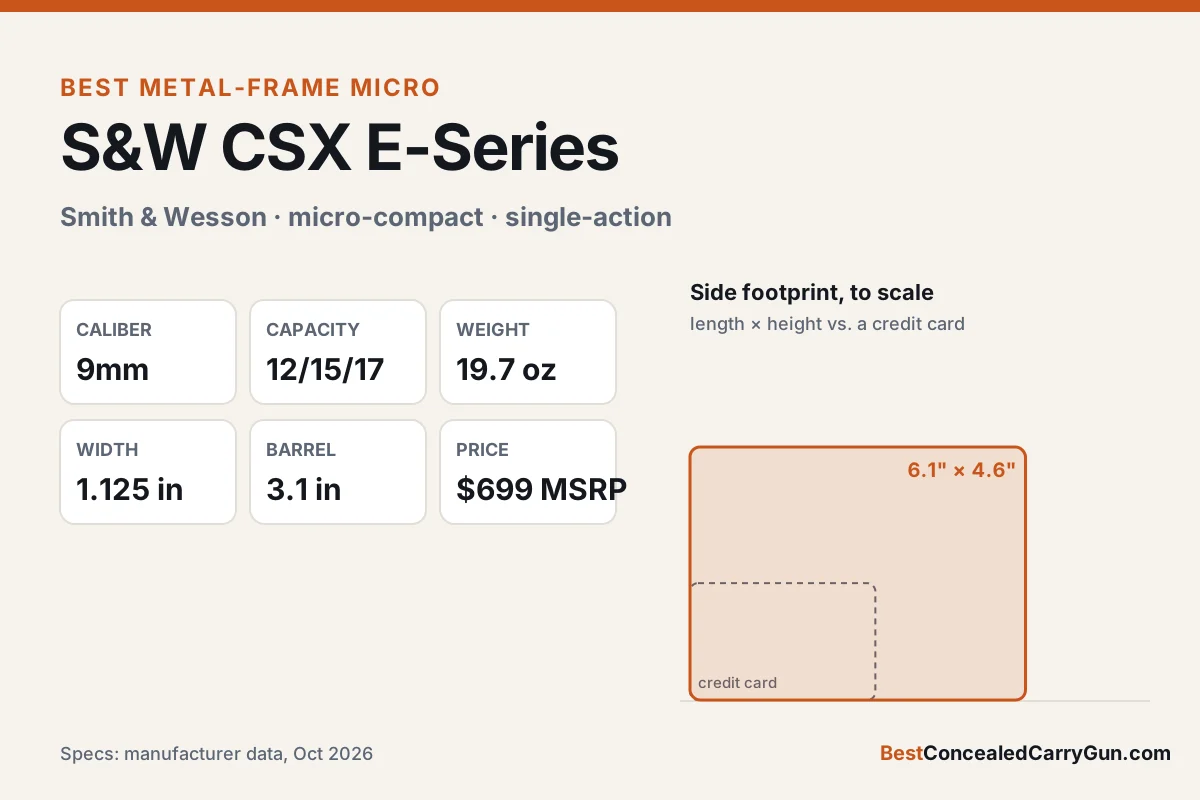
| Caliber | 9mm |
|---|---|
| Capacity | 12/15/17 rounds |
| Barrel | 3.1 in |
| Length × height | 6.1 × 4.6 in |
| Width | 1.125 in |
| Weight | 19.7 oz |
| Manual safety | Yes |
| Optics-ready | Yes |
| Price | $699 MSRP |
Why it made our list
The CSX is unusual in this class: an aluminum-alloy frame, a single-action hammer-fired trigger and an ambidextrous thumb safety — a mini-1911 approach in a modern micro-compact. S&W’s E-Series uses a modular grip that accepts 12-, 15- and 17-round magazines.
It weighs about 19.7 ounces with the 3.1-inch barrel and is optics-ready. If you learned on a 1911 or want a thumb safety that is part of the design rather than an add-on, it deserves a look.
Pros
- Aluminum frame
- Single-action trigger with ambi thumb safety
- 12/15/17-round grip options
Cons
- Thumb safety must be trained
- Higher price than polymer peers
Best for: 1911 fans and carriers who want a manual-safety-first design.
Skip it if: You want the simplest possible manual of arms.
CZ P-10 S
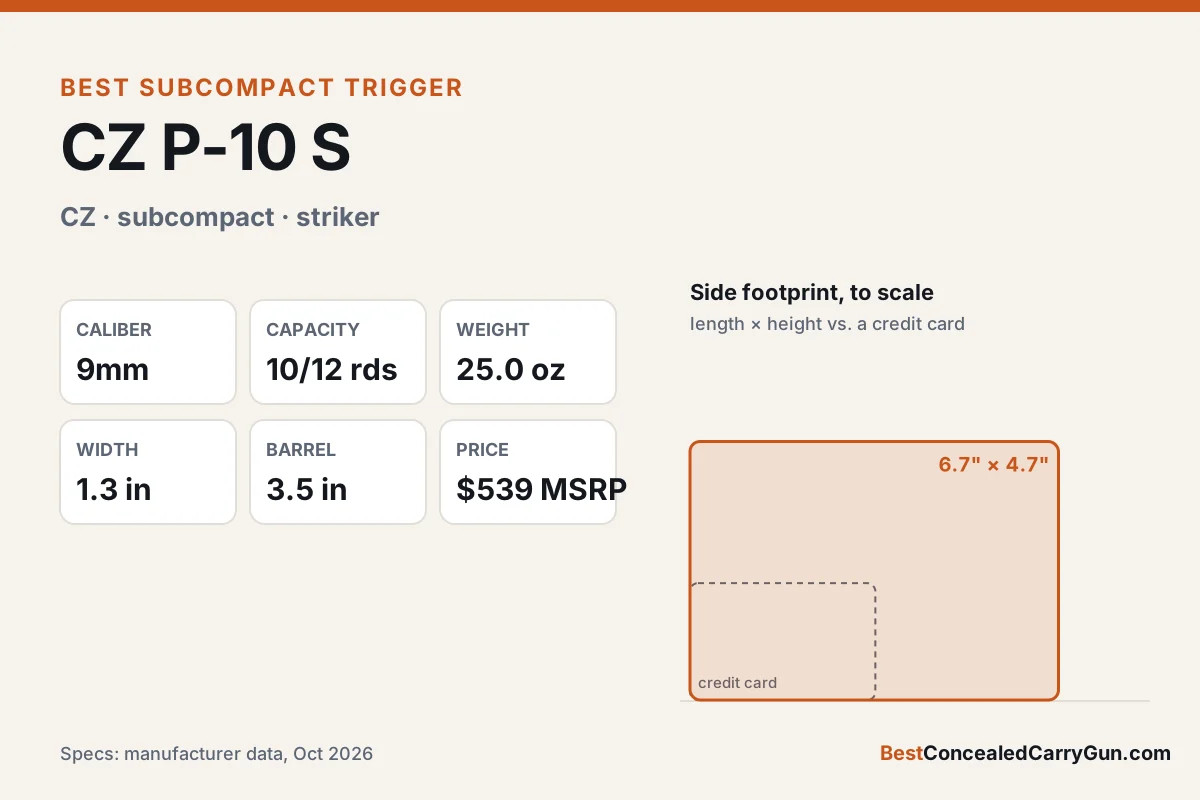
| Caliber | 9mm |
|---|---|
| Capacity | 10/12 rounds |
| Barrel | 3.5 in |
| Length × height | 6.7 × 4.7 in |
| Width | 1.3 in |
| Weight | 25.0 oz |
| Manual safety | No |
| Optics-ready | Some models |
| Price | $539 MSRP |
Why it made our list
CZ’s P-10 S is a double-stack 12+1 subcompact with a short-reset trigger that many shooters rank near the top of the class. The optics-ready OR model lists at $539 and adds co-witness sights.
It is thicker (1.3 inches) and heavier (about 25 ounces) than the micro-compacts, which helps control recoil but makes it a little harder to hide.
Pros
- Well-regarded trigger
- 12+1 capacity
- Optics-ready OR model
Cons
- 1.3 inches wide
- About 25 ounces
Best for: Shooters who prioritize trigger feel and accuracy in a small gun.
Skip it if: Thin and light is your top priority.
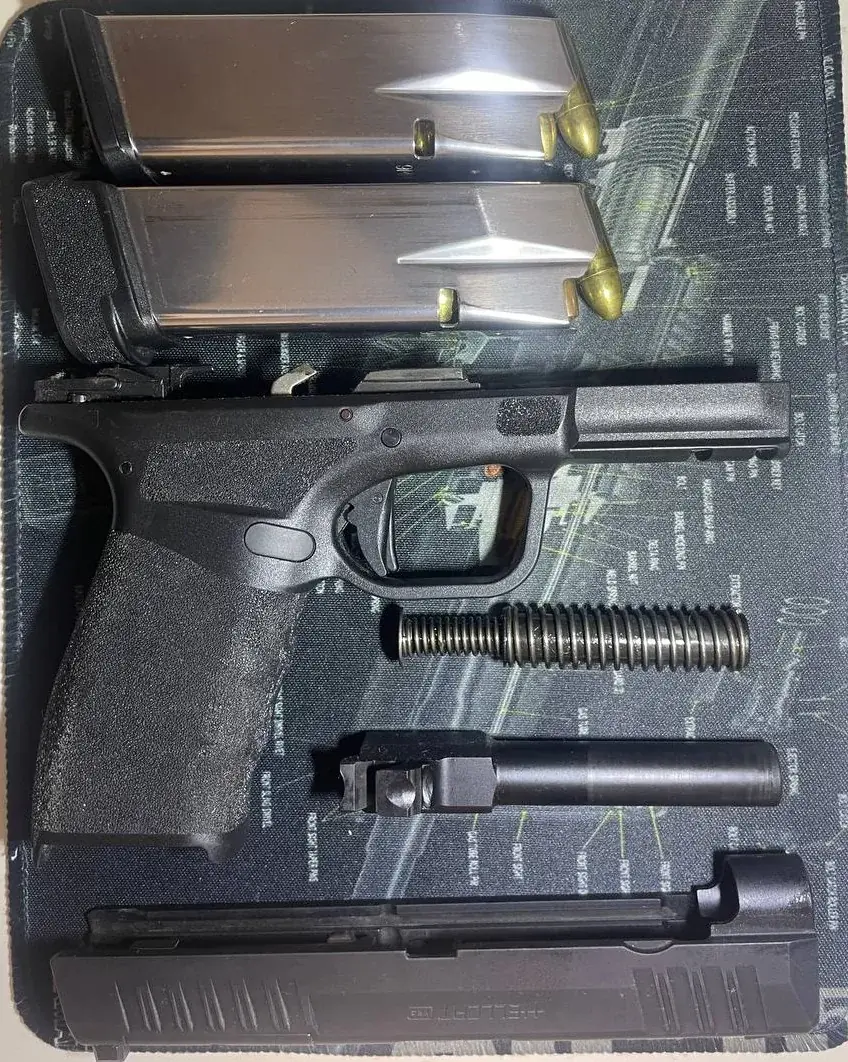
Springfield Hellcat Pro
| Caliber | 9mm |
|---|---|
| Capacity | 15/17 rounds |
| Barrel | 3.7 in |
| Length × height | 6.6 × 4.8 in |
| Width | 1.0 in |
| Weight | 21.0 oz |
| Manual safety | No |
| Optics-ready | Yes |
| Price | $670 MSRP |
Why it made our list
The Hellcat Pro keeps the 1-inch-wide grip but grows to a 3.7-inch barrel and a flush 15-round magazine (17-round extended included). It weighs about 21 ounces and is roughly the size of a P365-XL.
Think of it as the Hellcat for people who want more grip and more sight radius without moving to a full double-stack width.
Pros
- 15+1 flush in a 1-inch-wide grip
- Optics-ready
- Longer barrel than the Hellcat
Cons
- Taller grip prints more
- Same rough texture as the Hellcat
Best for: Larger-handed carriers who want capacity in a slim frame.
Skip it if: You want the smallest possible gun.
Honorable mentions
These guns are good choices that just missed the list, usually because a pick above does the same job a little better or with better support.
SIG P365-XL
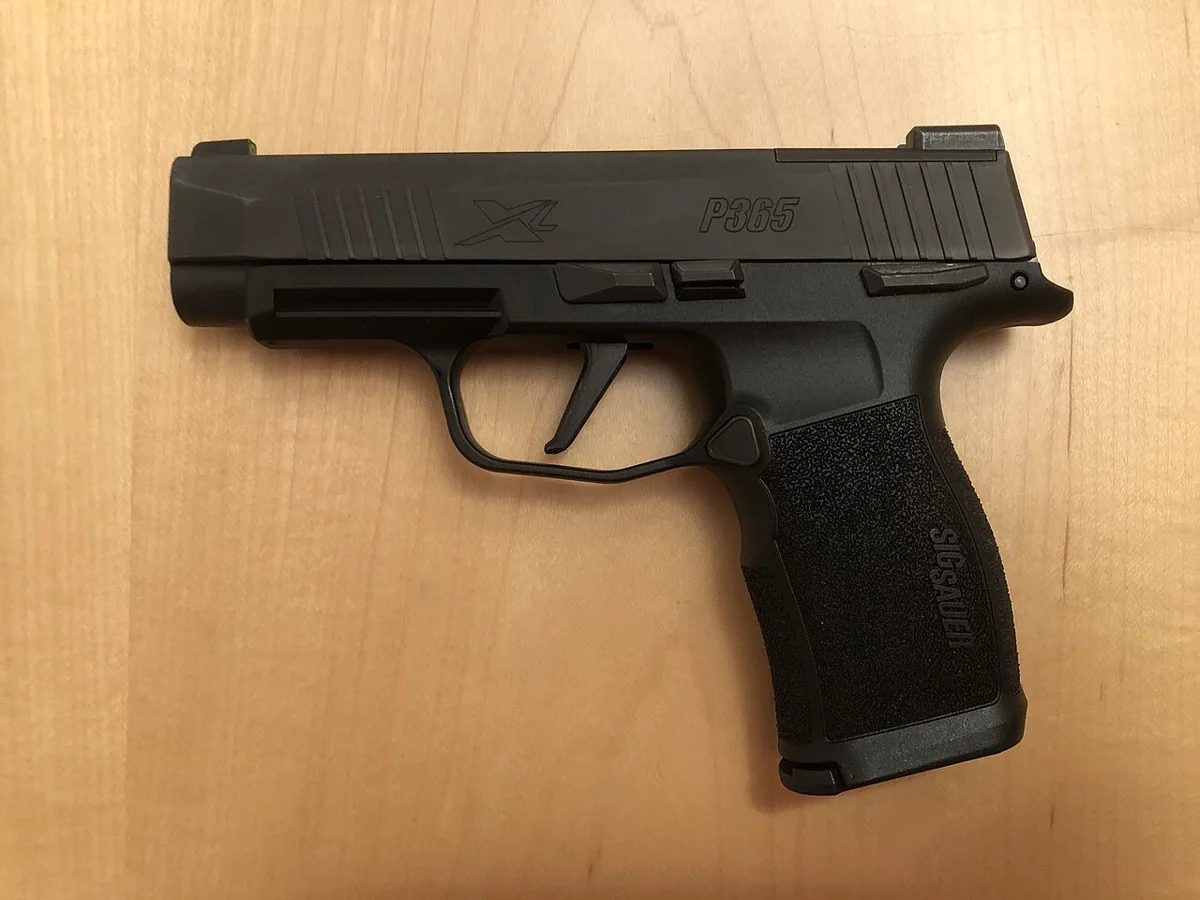
A 3.7-inch slide and 12+1 on the P365 platform — the middle ground between the P365 and XMACRO. 9mm, 10/12 rounds, 20.7 oz, $570 MSRP. Maker’s specs.
Mossberg MC2sc
Double-stack 11+1 / 14+1 subcompact with an optional cross-bolt safety model and an optic plate. 9mm, 11/14 rounds, 19.5 oz, $484 street. Maker’s specs.
Beretta APX A1 Carry
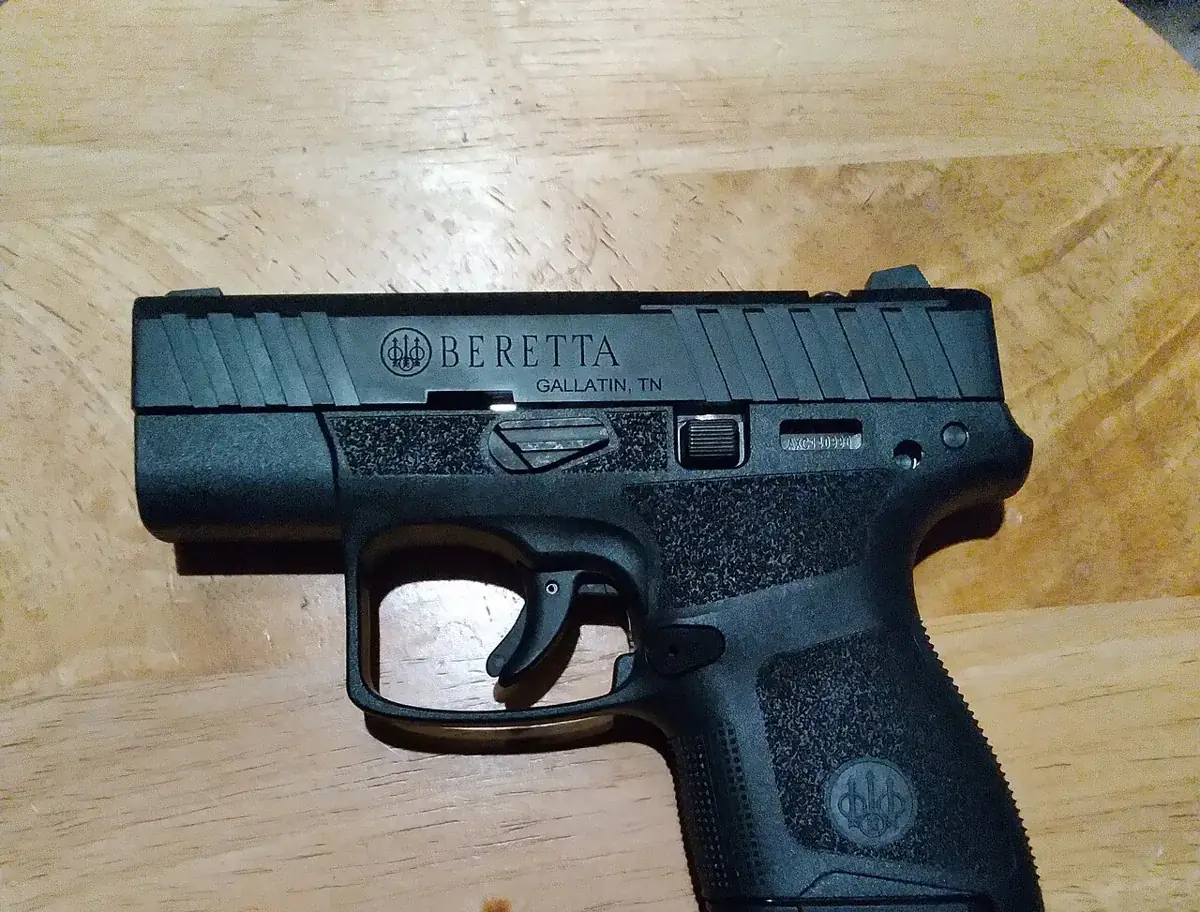
A 0.9-inch-wide single-stack with 6- and 8-round magazines and an optic-plate-ready slide, now listed from $409. 9mm, 6/8 rounds, 19.8 oz, $409 MSRP. Maker’s specs.
PSA Dagger Micro
A budget micro-compact (about $340) that PSA says is compatible with G43X/G48 frames, barrels and recoil assemblies. 9mm, 15 rounds, 15.9 oz, $340 MSRP. Maker’s specs.
Ruger RXM
A Ruger/Magpul compact with a removable stainless fire-control insert and Gen 3 Glock parts and holster compatibility. 9mm, 15/17 rounds, 23.2 oz, $539 MSRP. Maker’s specs.
Glock 26
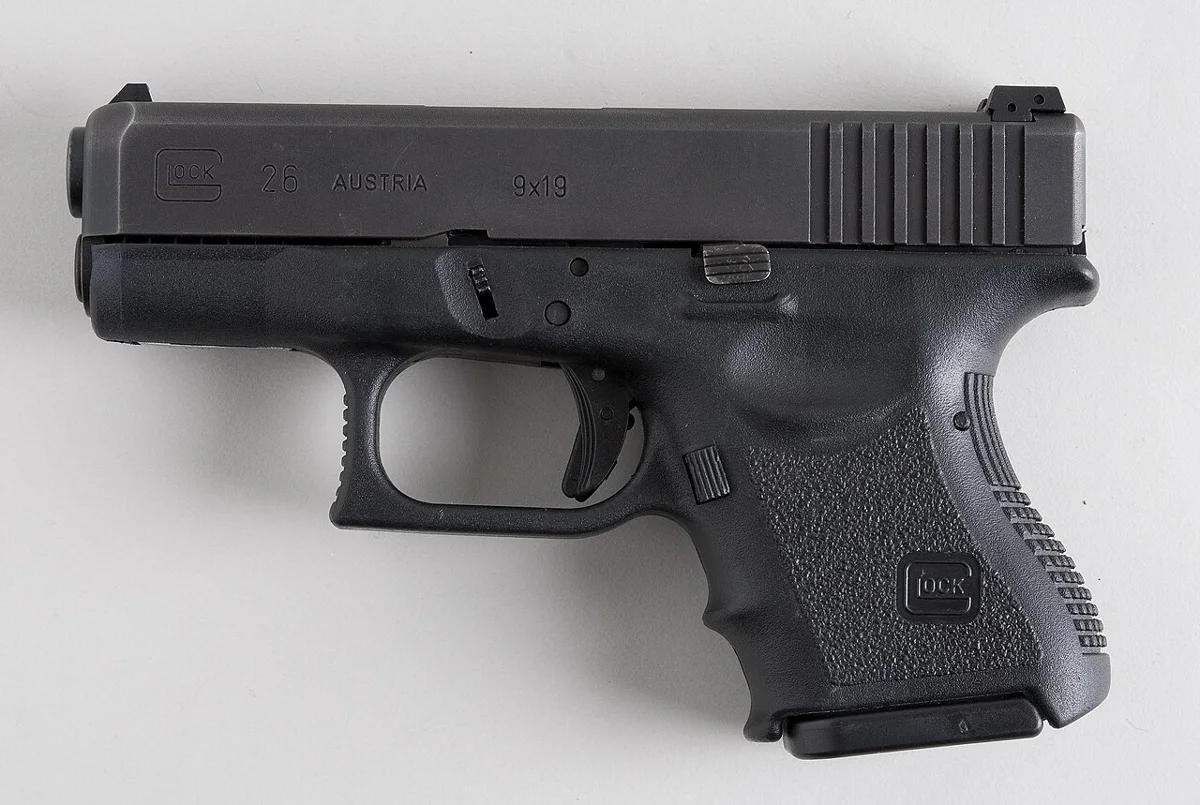
The original subcompact Glock: 10+1 that also accepts larger Glock 9mm magazines (now sold as the G26 V). 9mm, 10 rounds, 21.69 oz, $539 street. Maker’s specs.
Walther PDP Compact 4"
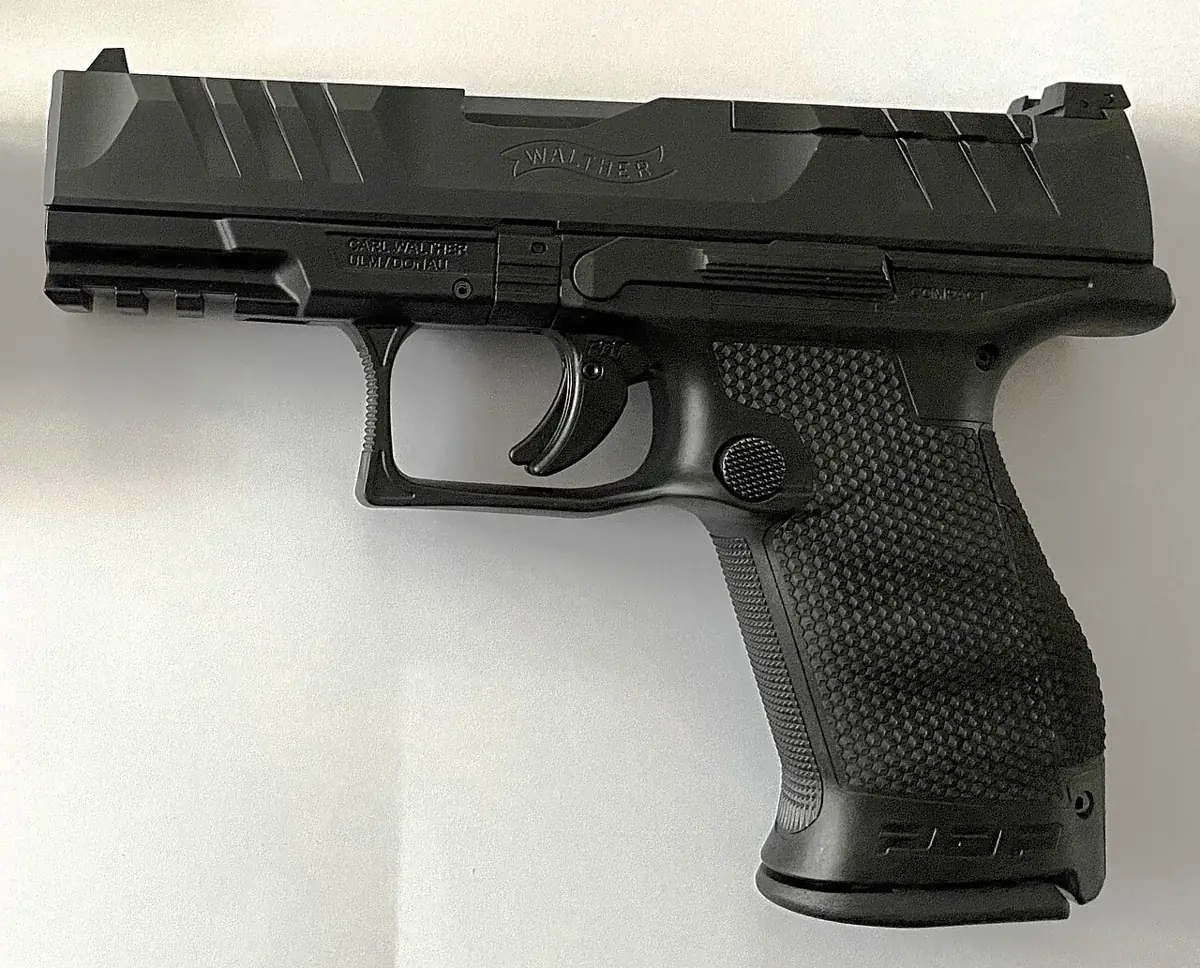
Full-size feel and an excellent trigger in a 15+1 compact — big for concealment, great for shooting. 9mm, 10/15 rounds, 24.4 oz, $699 MSRP. Maker’s specs.
Recalls, safety notices and discontinued guns
Popular carry guns sometimes leave this list for reasons that have nothing to do with how they shoot. Before you buy any used or discounted pistol, search the maker’s site for its model name plus “recall” or “safety notice.”
Taurus GX4: Taurus runs a GX4 safety notice (gx4safetynotice.com) saying some GX4 pistols sold in the U.S. may discharge if dropped, and asks owners to check their serial number. Until you have checked yours, we don’t recommend carrying one — that’s why the GX4 is not on our list despite its $359.99 MSRP. Source.
Staccato CS: Staccato says it discontinued the CS starting November 21, 2025 and is selling remaining stock while supplies last. It was a well-reviewed premium carry 2011, but we don’t list discontinued guns as picks. Source.
Ruger MAX-9: As of October 2026 Ruger lists only four MAX-9 models, all with a manual safety and all marked “Limited Availability.” Buy one if you find it at a good price, but expect the line to wind down. Source.
How to choose a concealed carry gun
Specs narrow the field; your hands, body, wardrobe and routine pick the winner. Work through these in order.
1. Decide how and where you will carry first
Most people carry inside the waistband (IWB), either strong-side around 3–4 o’clock or appendix (AIWB) around 12–1 o’clock. Pocket and ankle carry demand the smallest guns; off-body carry (bags) has its own risks. Your carry position decides the size of gun that will work, not the other way around. Our sister site explains the trade-offs in its IWB vs OWB holster guide, appendix carry guide and carry positions clock guide.
2. Grip length matters more than barrel length
The grip is what prints through a shirt, and the grip is also what lets you hold the gun firmly. A micro-compact with a short grip (like the standard P365) hides easily but may leave your pinky hanging; a long grip (like the P365-XMACRO or Glock 19) shoots better but needs a good belt, holster and cover garment. Barrel and slide length matter less for concealment when you carry inside the waistband, because they sit below the belt line.
3. Width and weight decide comfort
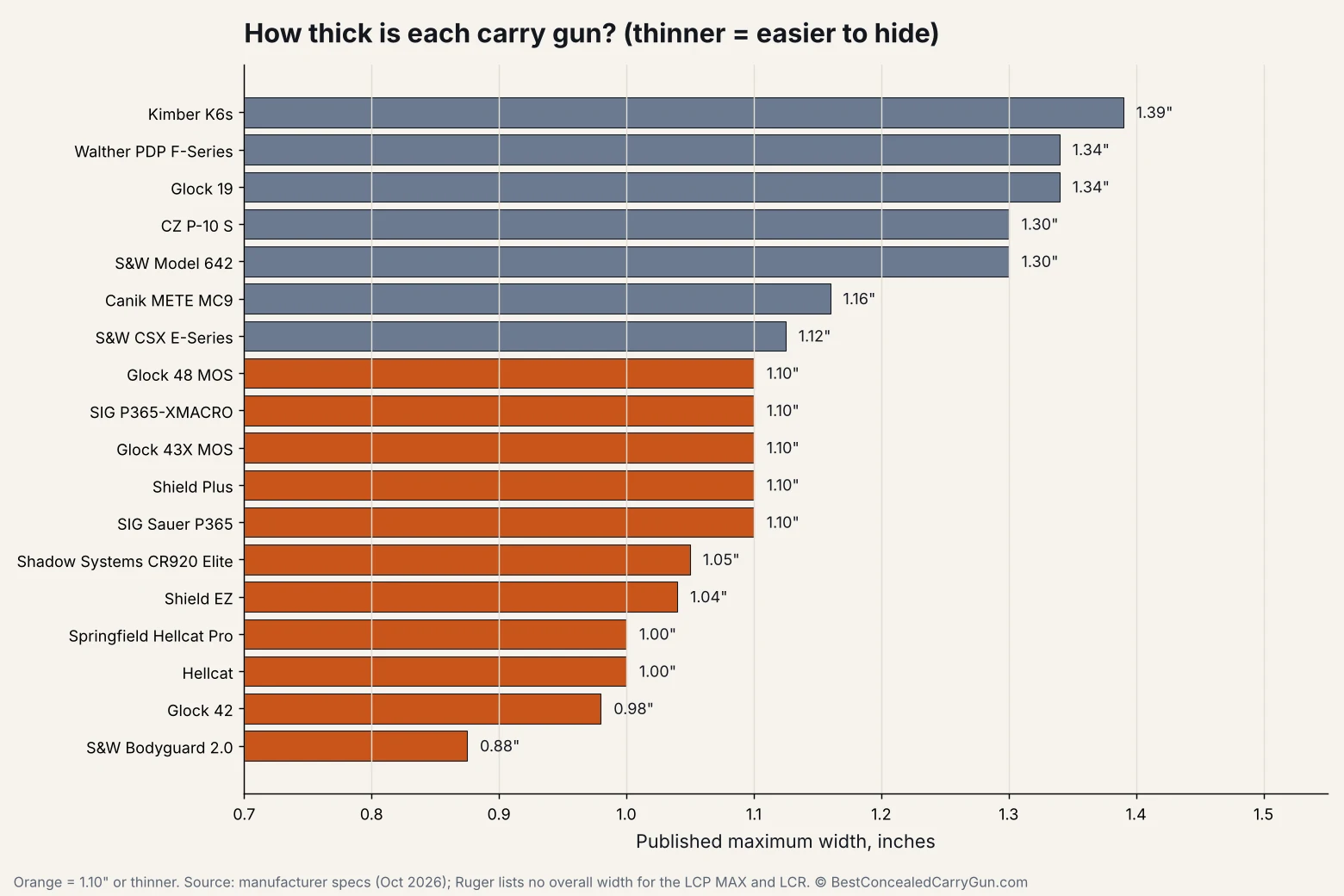
A difference of two-tenths of an inch in width, or five ounces in weight, is the difference between a gun you forget is there and a gun you leave home. Most of the micro-compacts on this list are 1.0–1.1 inches wide; compacts like the Glock 19 and Walther PDP are about 1.34 inches.
4. Make sure you can run it
Before you buy, rent or borrow the gun and check four things: can you reach the trigger with the pad of your finger while holding a high, firm grip; can you rack the slide reliably; can you lock the slide back and drop the magazine; and can you hit a paper plate at seven yards at a steady pace? If any answer is no, try a different model. The S&W Shield EZ and Walther PDP F-Series exist specifically for shooters who struggle with the first two.
5. Manual safety or not?
Modern striker-fired pistols without a manual safety rely on a quality holster that fully covers the trigger and on safe handling. Many new carriers prefer a thumb safety for peace of mind, especially for appendix carry. Both approaches are valid if you train with them. The P365, Shield Plus, Shield EZ, Bodyguard 2.0, LCP MAX and MC2sc are sold with optional thumb safeties; the CSX has one by design. Glock, the Hellcat and most revolvers do not.
Concealed carry guns with a manual safety
| Gun | Caliber | Manual thumb safety | Capacity | Weight |
|---|---|---|---|---|
| SIG Sauer P365 | 9mm | Optional (separate models) | 10 | 17.8 oz |
| S&W M&P9 Shield Plus | 9mm | Optional (separate models) | 10/13 | 17.9 oz |
| SIG P365-XMACRO | 9mm | Optional (separate models) | 10/17 | 22.0 oz |
| S&W M&P9 Shield EZ | 9mm | Optional (separate models) + grip safety | 8 | 23.0 oz |
| Ruger LCP MAX | .380 ACP | Optional (separate models) | 10/12 | 10.6 oz |
| S&W Bodyguard 2.0 | .380 ACP | Optional (separate models) | 10/12 | 9.8 oz |
| S&W CSX E-Series | 9mm | Standard | 12/15/17 | 19.7 oz |
| SIG Sauer P365-XL | 9mm | Optional (separate models) | 10/12 | 20.7 oz |
| Mossberg MC2sc | 9mm | Optional (separate models) | 11/14 | 19.5 oz |
| Ruger MAX-9 | 9mm | Standard | 10/12 | 18.4 oz |
From manufacturer model listings, October 2026. “Optional” means the maker sells versions with and without a thumb safety — check the exact model number. Glock, the Hellcat and the revolvers on our list do not offer one.
6. Optics-ready or iron sights?
Micro red dots are now common on carry guns and can make it easier to shoot accurately, especially as eyesight changes. They add cost, height and one more thing to maintain, and they take practice to find quickly from the holster. If you think you might want one later, buy an optics-ready model now — it is cheaper than milling a slide.
7. Match the gun to your hands
- Small hands: look for a short trigger reach and a slim grip — the Walther PDP F-Series was designed for exactly this, and the P365 and Hellcat have compact grips. If slide effort is the problem, start with the Shield EZ.
- Large hands: a short micro-compact grip leaves your pinky hanging and bunches your support hand. Choose a longer grip in the same thin frame: the P365-XMACRO, Hellcat Pro, Glock 48 or Glock 19.
- Left-handed shooters: check three controls before buying — whether the magazine release can be reversed (most modern carry pistols allow it), whether the slide stop is ambidextrous, and, if the gun has a manual safety, whether that safety can be worked from both sides. Then confirm the holster you want is made in a left-hand version.
8. If recoil is your main concern
Go bigger, not smaller. Recoil energy falls as gun weight rises, so the same 9mm load produces about 7.7 ft·lb in a 17.8-ounce P365 but about 5.8 ft·lb in a 23.6-ounce Glock 19 — roughly a quarter less. A .380 in a mid-size gun such as the Glock 42 is softer still. We estimate recoil for every gun we track in concealed carry guns with the least recoil.
Concealed carry size classes explained
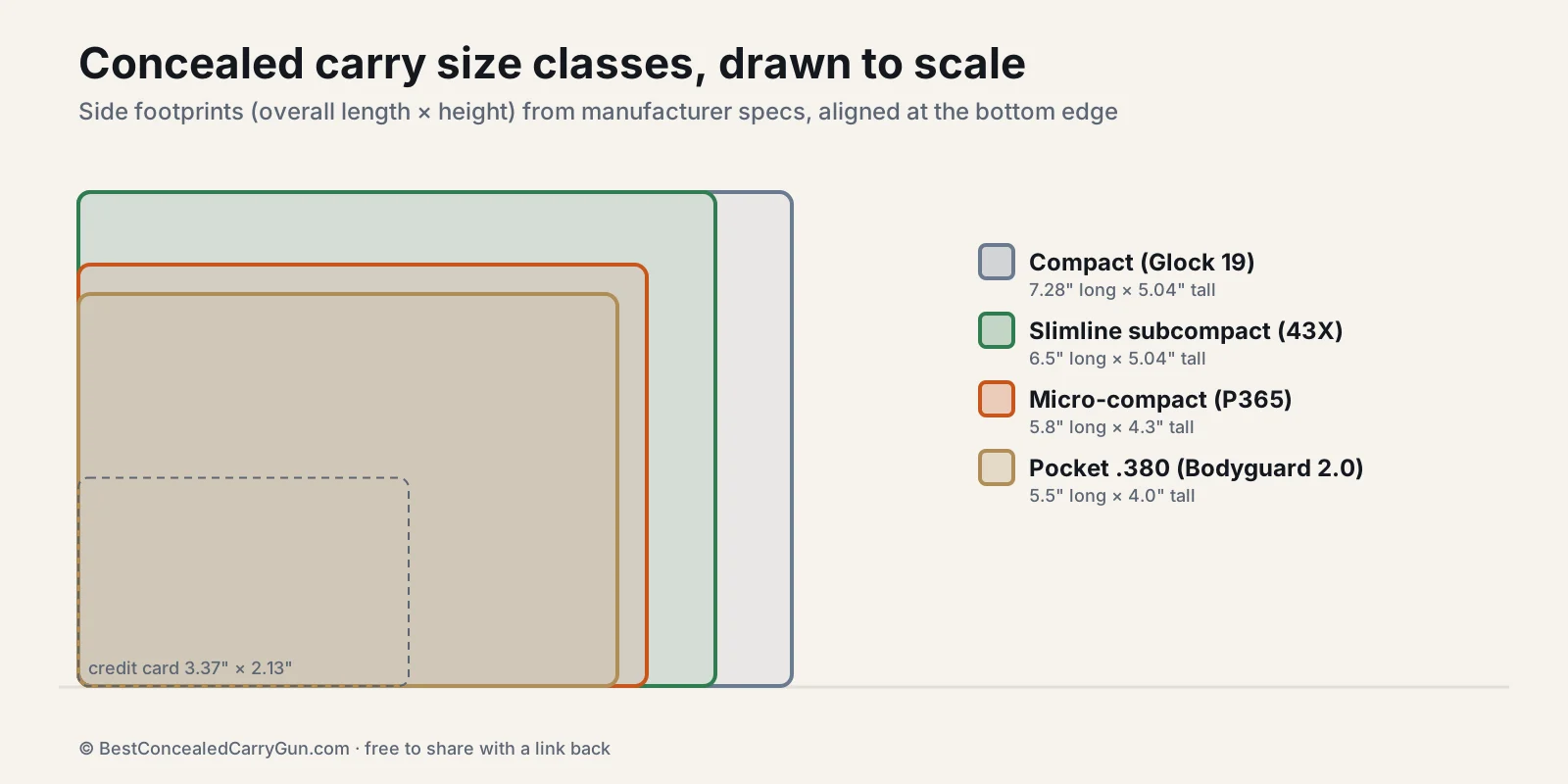
| Class | Typical size | Typical capacity | Examples | Best for |
|---|---|---|---|---|
| ~5–5.5″ long, ~4″ tall, 10–14 oz | 6–12 (.380) | Ruger LCP MAX, S&W Bodyguard 2.0 | Pocket carry, dress clothes, backup | |
| Micro-compact | ~5.8–6.1″ long, ~4–4.6″ tall, 17–19 oz | 10–13 (9mm) | SIG P365, Hellcat, Shield Plus | Everyday IWB/AIWB carry |
| Slimline / subcompact | ~6.5″ long, ~4.7–5″ tall, 18–25 oz | 10–12 | Glock 43X, CZ P-10 S, Glock 26 | IWB with a fuller grip |
| Compact | ~6.6–7.5″ long, ~4.8–5.4″ tall, 21–25 oz | 15–17 | Glock 19, P365-XMACRO, Walther PDP | Carry plus home defense and range use |
| Snub revolver | ~6.3–6.6″ long, ~4.3–4.5″ tall, 13–23 oz | 5–6 | Ruger LCR, S&W 642, Kimber K6s | Pocket, simple manual of arms |
Compare any two guns to scale with our handgun size comparison tool. Want the full breakdown? Read compact vs subcompact vs micro-compact, or jump straight to the best pocket pistols, smallest 9mm pistols and best micro-compact 9mm pistols.
Caliber: 9mm, .380, .38 Special or .357?
9mm Luger is the default for concealed carry: modern defensive hollow points perform well, ammunition is affordable for practice, and micro-compacts now hold 10–17 rounds of it. Unless you have a specific reason to choose otherwise, start with 9mm.
.380 ACP is smaller and generally less powerful. Its advantage is size — guns like the LCP MAX and Bodyguard 2.0 weigh around 10 ounces and disappear in a pocket — and, in larger .380s such as the Glock 42 and Shield EZ .380, softer recoil.
.38 Special and .357 Magnum revolvers trade capacity for simplicity. Most snub owners carry .38 Special +P; .357 Magnum from a two-inch barrel is loud and stout and usually reserved for heavier revolvers like the K6s.
Choose a caliber you can shoot accurately and quickly for follow-up shots, then pick a quality defensive load and confirm it feeds reliably in your gun. More detail: 9mm vs .380 for concealed carry and our handgun calibers chart, which compares 15 calibers by size, power and recoil.
Holster, belt and carry position: the half of the decision people skip
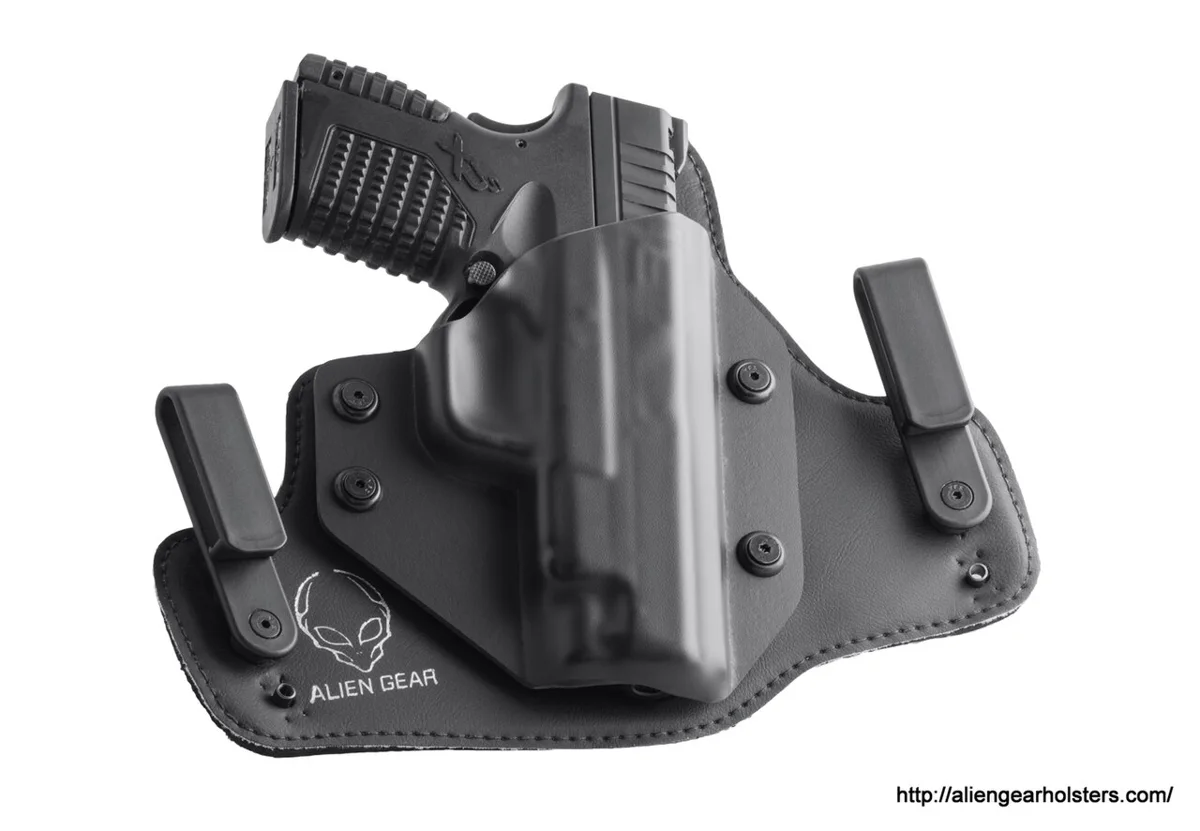
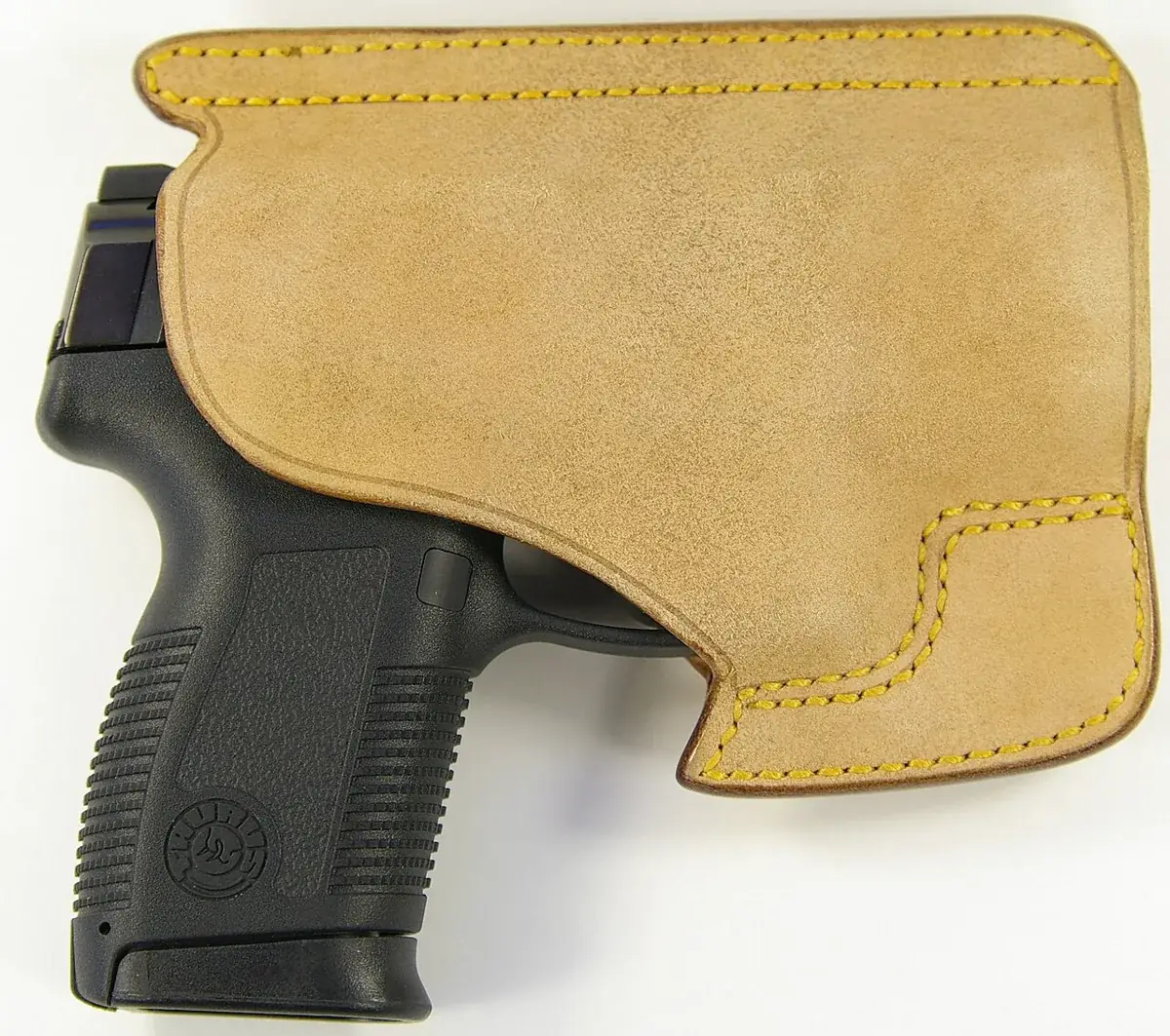
A mediocre gun in an excellent holster and belt is safer and more comfortable than an excellent gun in a cheap holster. Your holster must fully cover the trigger guard, hold the gun securely, and stay put when you draw. A purpose-built gun belt keeps the gun from sagging and printing. Start with our sister site’s guide to choosing a concealed carry holster, gun belt guide, holster retention levels and how to stop printing.
Pocket carry needs a dedicated pocket holster that keeps the gun upright and covers the trigger — never a bare gun in a pocket. Women’s clothing often lacks a sturdy belt line, so look at holster options for women, including belly bands and appendix rigs.
What a carry gun really costs
The gun is usually less than half of the first-year bill. Budget for the whole setup:
| Item | Typical range | Notes |
|---|---|---|
| Pistol | $300–$900 | Most picks above are $440–$720 |
| Quality holster | $60–$150 | Plan on buying more than one over time |
| Gun belt | $50–$120 | Stiff, purpose-built |
| Spare magazine + carrier | $40–$80 | Factory magazines recommended |
| Defensive ammunition | $30–$60 per box | Test a few boxes for reliability |
| Practice ammunition | $150–$400 / year | 500–1,000 rounds is a good first year |
| Permit & class | $0–$250+ | Varies widely by state |
| Safe storage | $30–$300 | Quick-access safe or lockbox |
On a tighter budget? See the best budget concealed carry guns. Amazon carries holsters, belts, lockboxes and range gear (not firearms) — for example concealed carry gun belts and quick-access handgun safes.
Your first 90 days with a new carry gun

- Learn the law where you live and travel. Permit requirements, prohibited places and reciprocity differ by state and change often. Check your state’s official sources. North Carolina residents can start with our sister site’s NC concealed carry laws guide.
- Take a class. Even where a permit is not required, a qualified instructor will fix grip, stance and safe holstering habits before they become bad habits.
- Shoot 200–300 rounds before you carry, including at least 100 rounds of the defensive ammunition you plan to carry, to confirm reliability with your gun and magazines.
- Dry-fire practice. With an empty gun and no ammunition in the room, practice drawing and presenting from concealment. Here are drills to start with.
- Wear it at home first. Carry for a few days around the house to fine-tune holster height and cant before you go out.
- Store it safely whenever it is not on your body, especially if children live in or visit your home.
Explore our concealed carry gun guides
- Best pocket pistols — the smallest guns that still work for daily carry
- Smallest 9mm pistols — the tiniest 9mms ranked by length, height and weight
- Best micro-compact 9mm pistols — P365, Hellcat, Shield Plus and rivals head to head
- Best Glock for concealed carry — 43X vs 48 vs 19 vs 26 vs 42
- Best concealed carry guns for women — fit, slide effort and recoil first
- Best concealed carry revolvers — LCR, J-frame, K6s and more
- Best .380 pistols for concealed carry — LCP MAX, Bodyguard 2.0, Glock 42
- Best concealed carry gun for beginners — easy to rack, easy to shoot
- Best budget concealed carry guns — good carry guns under $500
- Compact vs subcompact vs micro-compact — size classes explained
- 9mm vs .380 for concealed carry — which caliber makes sense for you
- Best SIG Sauer for concealed carry — P365 vs P365-XL vs XMACRO, and the P320 questions
- Concealed carry guns with the least recoil — recoil estimated for 28 guns
- Best concealed carry guns in California — roster-listed picks and the 2026 Glock ban
- Ruger MAX-9 review — still worth buying at $299?
- Handgun sizes chart + comparison tool — compare any two carry guns to scale
- Handgun calibers chart — 15 calibers by size, power and recoil
Concealed carry gun FAQ
What is the #1 concealed carry pistol?
There is no single #1 for everyone, but the SIG Sauer P365 is the most common answer for good reason: it carries 10+1 rounds of 9mm in a 1.1-inch-wide, 17.8-ounce micro-compact and is supported by a huge range of holsters, magazines and grip modules. The Springfield Hellcat, S&W Shield Plus and Glock 43X are close alternatives.
What caliber is best for concealed carry?
9mm is the best default for most people: it offers effective modern defensive ammunition, manageable recoil, affordable practice ammo and 10–17 rounds in today’s micro-compacts. .380 ACP makes sense for the smallest pocket guns or for shooters who are very recoil-sensitive.
Which is the best pistol to carry every day?
The best everyday carry pistol is the one you will carry all day and can shoot well. For most people that is a 9mm micro-compact such as the SIG P365, Springfield Hellcat or S&W Shield Plus, carried inside the waistband in a quality holster on a gun belt.
What type of concealed carry is best?
Inside-the-waistband (IWB) carry — either strong-side or appendix — conceals well and keeps the gun accessible for most body types. Pocket carry suits the smallest guns. The best method is the one that keeps the gun secure, the trigger covered and your draw consistent.
Is 9mm or .380 better for concealed carry?
9mm is generally the better choice because it is more powerful and modern micro-compact 9mms are nearly as small as many .380s. Choose .380 if you need a true pocket gun or if recoil or slide effort keeps you from shooting a 9mm well.
What is the most comfortable concealed carry gun?
Comfort comes from low weight, a thin frame and a good holster. Thin micro-compacts like the Hellcat (1.0 inch), Shield Plus and P365 (about 1.1 inches) and the ultralight Bodyguard 2.0 (9.8 oz) are among the most comfortable to carry all day.
What is the best concealed carry gun for a woman?
The best gun is the one that fits her hand and that she can rack and shoot confidently. The Walther PDP F-Series and S&W Shield EZ were designed with smaller hands and easier slide manipulation in mind; the SIG P365 and Hellcat are popular all-round choices.
What is the best concealed carry gun for beginners?
The S&W M&P9 Shield EZ is one of the easiest guns to rack and shoot, with a grip safety and optional thumb safety. The SIG P365 with a manual safety and the Glock 19 are also excellent first carry guns if you can operate them comfortably.
Should a concealed carry gun have a manual safety?
It is a personal choice. A manual safety adds a step you must train to disengage under stress; a gun without one depends on a holster that fully covers the trigger and on safe handling. Many beginners and appendix carriers prefer a thumb safety. Both work if you train consistently.
How much does a good concealed carry gun cost?
Most of our picks list for about $440–$720. Budget models such as the Canik METE MC9 start around $440 MSRP, while premium options like the Shadow Systems CR920 Elite and Kimber K6s cost $800–$1,000+. Plan another $200–$400 for a holster, belt, spare magazine and ammunition.
Is a revolver good for concealed carry?
Yes, for the right person. Snub revolvers like the Ruger LCR and S&W 642 are simple to operate and carry well in a pocket, but they hold only five or six rounds, reload slowly and can be harder to shoot accurately than a micro-compact pistol.
What are the top 5 concealed carry handguns?
Our top five for 2026 are the SIG Sauer P365, Springfield Hellcat, S&W M&P9 Shield Plus, Glock 43X MOS and SIG P365-XMACRO. All are slim 9mm pistols with 10–17 round capacity, wide holster support and long track records.
What is the most popular concealed carry handgun?
The SIG Sauer P365. GunGenius’s 2025 GunBroker sales data ranked it the best-selling handgun of the year, followed by the Glock 19 and Glock 43X — all three popular carry guns. Manufacturers do not publish model-by-model sales, so marketplace data like this is the best public indicator.
What is the best concealed carry gun with a manual safety?
The SIG P365 in its -MS manual-safety versions for most people. The S&W Shield Plus thumb-safety model is the value alternative, the S&W CSX has an ambidextrous thumb safety as standard, and the Shield EZ adds a grip safety with an optional thumb safety. See the manual-safety table above.
What handgun has the least recoil for concealed carry?
Heavier guns in smaller calibers recoil least. Of the guns we track, the Glock 42 (.380) has the lowest estimated recoil energy, followed by heavier 9mm compacts like the Glock 19 and Walther PDP. The S&W Shield EZ is the easiest overall package for recoil-sensitive shooters because its slide is also easy to rack.
What is the best concealed carry gun for small hands?
Look for a short trigger reach and a slim grip. The Walther PDP F-Series was designed around smaller hands, and the SIG P365 and Springfield Hellcat have compact grips. If slide effort is the issue, the S&W Shield EZ is the easiest to rack.
Can you carry a gun without a holster?
In many places it is legal, but tucking a bare gun into a waistband (sometimes called “Mexican carry”) is unsafe: nothing covers the trigger, the gun can shift or fall out, and your draw is inconsistent. Use a holster that fully covers the trigger guard and stays put on your belt.
What is the best concealed carry gun in California?
A roster-listed SIG P365 for most people, followed by the Springfield Hellcat and the S&W Shield Plus OR added in September 2026. Since July 1, 2026, AB 1127 bars dealers from selling new Glock-pattern pistols. Always confirm the exact model on the California DOJ roster.
Is the Ruger MAX-9 a good concealed carry gun?
Yes, for the money: 12+1 rounds, 18.4 ounces and an optics-ready slide on non-California models for $299–$449. Ruger now marks every MAX-9 “Limited Availability,” so long-term accessory support may thin out.
What is the smallest 9mm pistol for concealed carry?
Among the 9mm guns on this list, the SIG P365 (5.8 × 4.3 inches) and Springfield Hellcat (6.0 × 4.0 inches) are the smallest high-capacity options; the Hellcat’s grip is 1 inch wide. Single-stack guns like the Beretta APX A1 Carry (0.9 inch wide) are thinner but hold fewer rounds.
Update log
- October 12, 2026 (update): Added the top-5 summary, what’s new for 2026, a manual-safety table, hand-size and recoil guidance, eight new FAQs, and new guides to calibers, sizes, recoil, SIG pistols, the Ruger MAX-9 and California’s roster and AB 1127.
- October 12, 2026: Guide published. Specs and prices checked against manufacturer websites; added the Glock G19 V/Gen6 change, the Taurus GX4 safety notice, the Staccato CS discontinuation and Ruger MAX-9 availability.