
Quick answer
Common handgun calibers from smallest bullet to largest: .22 LR → .22 WMR → .25 ACP → .32 ACP / .30 Super Carry → .380 ACP → 9mm Luger → .38 Special → .357 Magnum → .40 S&W → 10mm → .44 Magnum → .45 ACP. For concealed carry, 9mm Luger is the best default: effective modern ammunition, manageable recoil, cheap practice ammo and 10–17 rounds in today’s micro-compacts. .380 ACP suits pocket guns and recoil-sensitive shooters; .38 Special is the snub-revolver standard.
“Caliber” is one of the most confusing parts of choosing a handgun because the names mix inches, millimeters and marketing. This chart lines up the cartridges you will actually see in a gun shop, with the four numbers that matter — bullet diameter, case length, muzzle energy and recoil — and tells you which ones make sense for concealed carry. All figures are typical factory loads from manufacturer-published ballistics; real loads vary with bullet weight and barrel length.
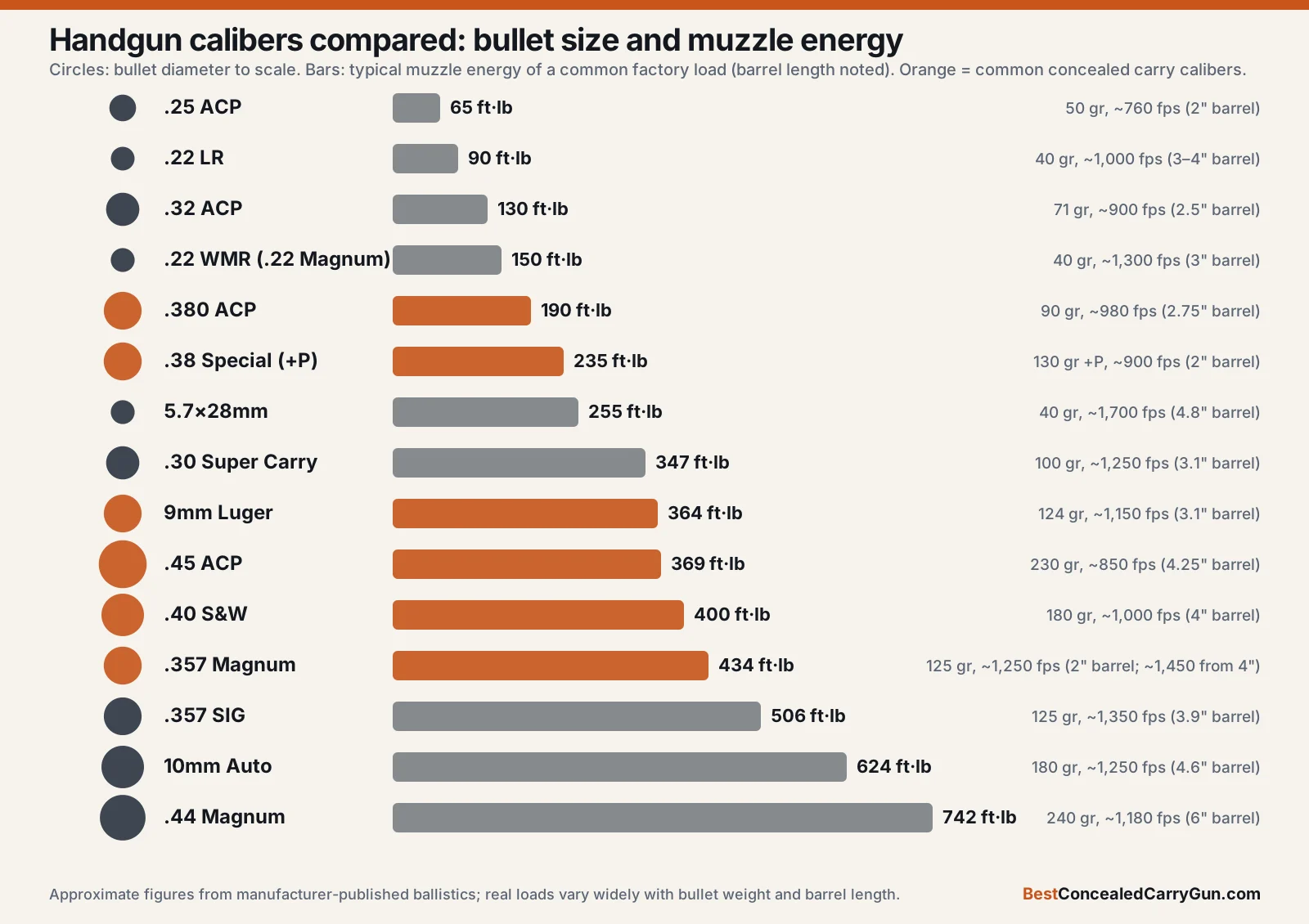
Handgun calibers chart: smallest to largest
| Caliber | Bullet dia. | Case length | Typical load | Muzzle energy | Recoil energy | Carry-gun capacity | Common carry guns | Role |
|---|---|---|---|---|---|---|---|---|
| .22 LR | 0.223″ | 0.613″ | 40 gr, ~1,000 fps (3–4" barrel) | 90 ft·lb | 0.7 ft·lb (15 oz gun) | 8–10 | S&W M&P 22 Compact, Ruger LCP II Lite Rack .22 | Practice; last-resort carry only |
| .22 WMR (.22 Magnum) | 0.224″ | 1.055″ | 40 gr, ~1,300 fps (3" barrel) | 150 ft·lb | 1.8 ft·lb (16 oz gun) | 6–9 | Ruger LCR .22 Mag, S&W M&P 22 Magnum, KelTec PMR-30 | Low recoil; rimfire reliability caveat |
| 5.7×28mm | 0.224″ | 1.135″ | 40 gr, ~1,700 fps (4.8" barrel) | 255 ft·lb | 1.7 ft·lb (25 oz gun) | 20 | FN Five-seveN, Ruger-57, S&W M&P 5.7 | Niche; low recoil, large pistols |
| .25 ACP | 0.251″ | 0.615″ | 50 gr, ~760 fps (2" barrel) | 65 ft·lb | 0.8 ft·lb (13 oz gun) | 6–7 | Vintage pocket pistols | Obsolete; avoid for defense |
| .32 ACP | 0.312″ | 0.680″ | 71 gr, ~900 fps (2.5" barrel) | 130 ft·lb | 2.0 ft·lb (14 oz gun) | 7–8 | KelTec P32, older Walther PP/PPK and Beretta Tomcat | Deep concealment; light recoil |
| .30 Super Carry | 0.312″ | 0.827″ | 100 gr, ~1,250 fps (3.1" barrel) | 347 ft·lb | 6.3 ft·lb (18 oz gun) | 13–16 | S&W Shield Plus 30 SC, Nighthawk 1911s | New (2022) 9mm alternative; limited ammo |
| .380 ACP | 0.355″ | 0.680″ | 90 gr, ~980 fps (2.75" barrel) | 190 ft·lb | 4.8 ft·lb (11 oz gun) | 6–12 | Ruger LCP MAX, S&W Bodyguard 2.0, Glock 42, Shield EZ .380 | Pocket pistols; recoil-sensitive shooters |
| 9mm Luger | 0.355″ | 0.754″ | 124 gr, ~1,150 fps (3.1" barrel) | 364 ft·lb | 7.6 ft·lb (18 oz gun) | 10–17 | SIG P365, Springfield Hellcat, Glock 19, S&W Shield Plus | The concealed carry default |
| .357 SIG | 0.355″ | 0.865″ | 125 gr, ~1,350 fps (3.9" barrel) | 506 ft·lb | 8.5 ft·lb (25 oz gun) | 10–13 | SIG P229, Glock 32/33 | Niche; expensive ammo |
| .38 Special (+P) | 0.357″ | 1.155″ | 130 gr +P, ~900 fps (2" barrel) | 235 ft·lb | 6.6 ft·lb (14 oz gun) | 5–6 | Ruger LCR, S&W 642, Kimber K6s (in .357) | Snub-nose revolvers |
| .357 Magnum | 0.357″ | 1.290″ | 125 gr, ~1,250 fps (2" barrel; ~1,450 from 4") | 434 ft·lb | 10.3 ft·lb (23 oz gun) | 5–6 | Kimber K6s, Ruger LCR .357, S&W 640 | Powerful; harsh in light snubs |
| .40 S&W | 0.400″ | 0.850″ | 180 gr, ~1,000 fps (4" barrel) | 400 ft·lb | 9.5 ft·lb (23 oz gun) | 9–15 | Glock 23/27, S&W M&P40 M2.0 | Declining; snappy recoil |
| 10mm Auto | 0.400″ | 0.992″ | 180 gr, ~1,250 fps (4.6" barrel) | 624 ft·lb | 13.2 ft·lb (27 oz gun) | 8–15 | Glock 29, S&W M&P 10mm M2.0, Springfield XD-M Elite 10mm | Woods/bear defense; large guns |
| .44 Magnum | 0.429″ | 1.285″ | 240 gr, ~1,180 fps (6" barrel) | 742 ft·lb | 15.9 ft·lb (44 oz gun) | 5–6 | S&W Model 629, Ruger Super Redhawk | Hunting; impractical to conceal |
| .45 ACP | 0.451″ | 0.898″ | 230 gr, ~850 fps (4.25" barrel) | 369 ft·lb | 9.6 ft·lb (26 oz gun) | 6–10 | Commander- and Officer-size 1911s, compact .45 polymer pistols | Classic big-bore; heavier guns |
Sorted by bullet diameter. Muzzle energy is for the typical load and barrel length shown; recoil energy is free recoil computed from that load in a gun of the stated weight (standard formula, powder gas at 4,000 fps). Treat both as comparisons, not absolutes.
Handgun calibers in order of power
Ranked by typical muzzle energy, the same cartridges look like this. Notice that the “big” .45 ACP sits right next to 9mm — it throws a much heavier bullet, but slower — and that barrel length moves .357 Magnum a long way: about 430 ft·lb from a 2-inch snub versus well over 550 ft·lb from a 4-inch revolver.
- .25 ACP — about 65 ft·lb (50 gr, ~760 fps (2" barrel))
- .22 LR — about 90 ft·lb (40 gr, ~1,000 fps (3–4" barrel))
- .32 ACP — about 130 ft·lb (71 gr, ~900 fps (2.5" barrel))
- .22 WMR (.22 Magnum) — about 150 ft·lb (40 gr, ~1,300 fps (3" barrel))
- .380 ACP — about 190 ft·lb (90 gr, ~980 fps (2.75" barrel))
- .38 Special (+P) — about 235 ft·lb (130 gr +P, ~900 fps (2" barrel))
- 5.7×28mm — about 255 ft·lb (40 gr, ~1,700 fps (4.8" barrel))
- .30 Super Carry — about 347 ft·lb (100 gr, ~1,250 fps (3.1" barrel))
- 9mm Luger — about 364 ft·lb (124 gr, ~1,150 fps (3.1" barrel))
- .45 ACP — about 369 ft·lb (230 gr, ~850 fps (4.25" barrel))
- .40 S&W — about 400 ft·lb (180 gr, ~1,000 fps (4" barrel))
- .357 Magnum — about 434 ft·lb (125 gr, ~1,250 fps (2" barrel; ~1,450 from 4"))
- .357 SIG — about 506 ft·lb (125 gr, ~1,350 fps (3.9" barrel))
- 10mm Auto — about 624 ft·lb (180 gr, ~1,250 fps (4.6" barrel))
- .44 Magnum — about 742 ft·lb (240 gr, ~1,180 fps (6" barrel))
Handgun caliber recoil chart
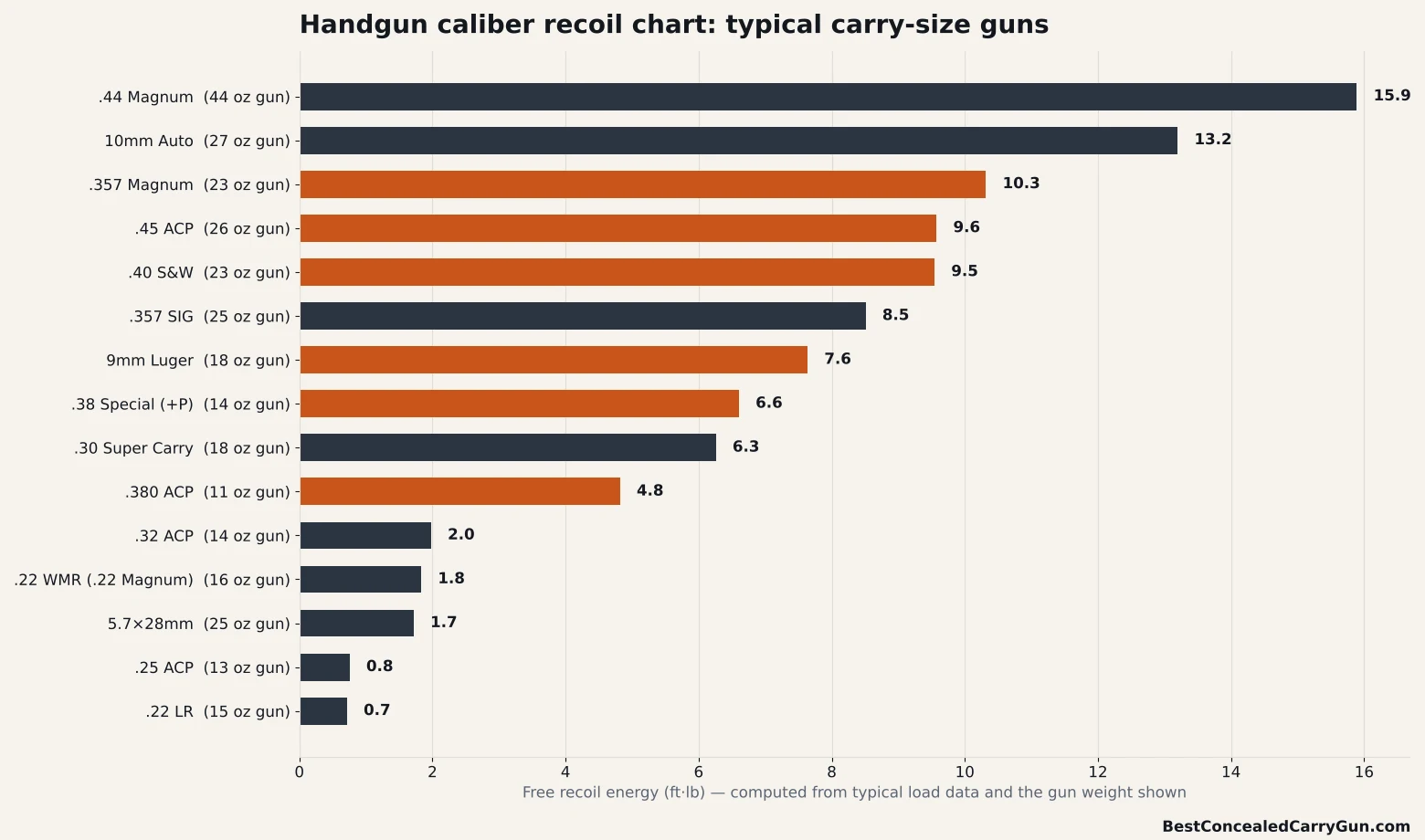
Recoil comes from the bullet weight, its velocity and the gun’s weight. That is why a 10-ounce .380 pocket pistol can feel sharper than an 18-ounce 9mm, and why heavy steel guns shoot big calibers comfortably. If recoil is your main concern, see our softest-shooting concealed carry guns, which estimates recoil for every gun we track.
What “caliber” actually means
Caliber is the approximate diameter of the bullet, written either in inches (.380, .45) or millimeters (9mm, 10mm). The names are historical, not precise: 9mm Luger, .380 ACP and .357 SIG all fire a .355-inch bullet; .38 Special and .357 Magnum both fire a .357-inch bullet; .40 S&W and 10mm Auto both use .400-inch bullets. What separates them is the case — its length and the pressure it is loaded to — which decides how fast the bullet leaves the barrel.
- Is 9mm smaller than .30 caliber? No. 9mm is .355 inch, which is larger than a .30-caliber (.308–.312 inch) bullet. The .30 Super Carry uses a .312 bullet and is the “.30 caliber” pistol round.
- What caliber is smaller than 9mm? .380 ACP uses the same diameter bullet but a shorter, lower-pressure case; genuinely smaller bullets include .32 ACP, .30 Super Carry, .25 ACP, .22 WMR and .22 LR.
- Is .380 the same as 9mm? No. .380 ACP is 9×17mm; 9mm Luger is 9×19mm. They are not interchangeable.
- Are all 9mm bullets the same size? Same diameter, different weights — usually 115, 124 or 147 grains — which changes velocity, recoil and penetration.
- Can a .357 Magnum revolver shoot .38 Special? Yes; the reverse is not true. Many owners carry .38 Special +P in a .357 snub for lighter recoil.
The calibers that matter for concealed carry
9mm Luger — the default
Nearly every gun on our best concealed carry guns of 2026 list is a 9mm, and for good reason: in the mid-2010s the FBI returned to 9mm, citing its own testing that modern 9mm hollow points perform on par with .40 and .45 while letting shooters carry more rounds and make faster, more accurate follow-up shots, and many police agencies followed. Practice ammunition is typically the least expensive of the common centerfire pistol cartridges. See the best micro-compact 9mm pistols.
.380 ACP — pocket guns and soft shooters
Less powerful than 9mm but it fits into guns like the Ruger LCP MAX and S&W Bodyguard 2.0 that weigh about 10 ounces. In a larger gun such as the Glock 42 or Shield EZ .380 it is also the softest-recoiling centerfire option most people will consider. Choose a proven defensive load; .380 has less margin for a poor bullet. Compare in 9mm vs .380 and the best .380 pistols.
.38 Special and .357 Magnum — snub revolvers
.38 Special +P is what most people carry in a lightweight snub like the Ruger LCR or S&W 642. .357 Magnum from a 2-inch barrel is powerful but loud and harsh in a light gun; it makes more sense in a heavier revolver such as the Kimber K6s. See the best concealed carry revolvers.
.45 ACP, .40 S&W and 10mm — the big bores
.45 ACP has a loyal following and shoots with a slower “push” than the snap of .40 S&W, but carry-size .45s hold 6–10 rounds and weigh more. .40 S&W has fallen out of favor since the 9mm shift; it is a fine caliber if you already shoot it well. 10mm Auto is a powerful woods and bear-defense cartridge that is rarely a good concealed carry choice because of gun size and recoil. If you want a .45, a Commander-size 1911, Glock 30S or Springfield XD-S Mod.2 are the usual starting points.
.30 Super Carry — the new one
Introduced by Federal in 2022, .30 Super Carry uses a .312-inch bullet at 9mm-like energy so that a gun the size of a Shield Plus can hold a few more rounds (13+1/16+1 in the Shield Plus 30 SC). Ammunition choice and availability remain limited compared with 9mm.
.22 LR and .22 WMR — only with eyes open
Rimfire cartridges are the softest-shooting option and the lightest guns, which makes them attractive to shooters with limited hand strength. Their downsides are low power and rimfire priming, which is less reliable than centerfire. If a .22 is the only gun someone can run, a quality .22 beats no gun — but a .380 in an easy-racking pistol like the Shield EZ is a better answer for most people.
Which caliber is best for self-defense?
Defensive ammunition is commonly judged against the FBI protocol, which looks for 12–18 inches of penetration in ballistic gelatin with reliable expansion. Quality loads in 9mm, .40, .45, .357 Magnum and .38 Special +P all meet it; several good .380 loads do as well. Since all of these can do the job, the deciding factors become whether you can shoot the gun fast and accurately, how many rounds it holds, and whether you will carry it every day. That is why 9mm in a gun that fits you wins for most people.
“Stopping power” rankings that put big calibers first ignore the biggest variable, which is where the bullet goes. Two fast, accurate 9mm hits beat one slow .45 miss. Choose the most powerful caliber you can shoot well, then spend the savings on practice ammunition.
Capacity by caliber
Smaller cartridges mean more rounds in the same grip. In carry-size guns, 9mm micro-compacts hold 10–13 rounds flush and 15–17 in compacts (SIG P365-XMACRO, Glock 19); .380 pocket guns hold 6–12; .45 ACP subcompacts 6–10; and snub revolvers 5–6. The largest-capacity handguns overall are full-size 9mms with extended magazines and 5.7×28mm pistols, which hold 20 or more rounds as standard — but those are not concealed carry guns for most people.
Bear and backwoods protection
If your question is “what handgun for bear protection,” the usual answers are 10mm Auto (Glock 20/29, S&W M&P 10mm) and .44 Magnum revolvers loaded with heavy, hard-cast bullets, carried in a chest holster rather than concealed. Bear spray remains the first line of defense recommended by wildlife agencies. None of these are sensible everyday concealed carry guns.
FAQ
What are the handgun calibers in order from smallest to largest?
By bullet diameter: .22 LR (.223″), .22 WMR (.224″), .25 ACP (.251″), .32 ACP and .30 Super Carry (.312″), .380 ACP / 9mm / .357 SIG (.355″), .38 Special / .357 Magnum (.357″), .40 S&W / 10mm (.400″), .44 Magnum (.429″) and .45 ACP (.451″).
What handgun caliber has the least recoil?
.22 LR has the least recoil of any common handgun caliber. Among defensive centerfire calibers, .380 ACP in a mid-size gun (such as the Glock 42 or Shield EZ .380) and 9mm in a heavier compact (such as the Glock 19) are the softest-shooting choices.
What caliber has the most stopping power?
Among common handgun calibers, 10mm Auto, .357 Magnum and .44 Magnum produce the most muzzle energy. For self-defense, shot placement and the ability to fire quick follow-up shots matter more than raw energy, which is why 9mm is the most common defensive choice.
Is 9mm good for concealed carry?
Yes — 9mm is the most popular concealed carry caliber in the U.S. because it balances effectiveness, manageable recoil, capacity and ammunition cost better than any alternative.
What is the best handgun cartridge for self-defense?
For most people, a quality 9mm hollow point (124- or 147-grain) from a reputable maker. It meets the FBI penetration standard, recoils moderately and lets you carry 10–17 rounds in a small gun.
What is the difference between handgun calibers like 9mm, .38 and .357?
They use nearly the same bullet diameter (.355–.357 inch). The differences are the case and pressure: .38 Special is a low-pressure revolver round, 9mm Luger is a higher-pressure pistol round, and .357 Magnum is a longer, much more powerful revolver round that also chambers .38 Special.